Updated April 27, 2023 12:00AM
The 4 Phases Of The Freestyle Swim Stroke
Look at each phase of your freestyle swim stroke to find areas where you can improve quickly.
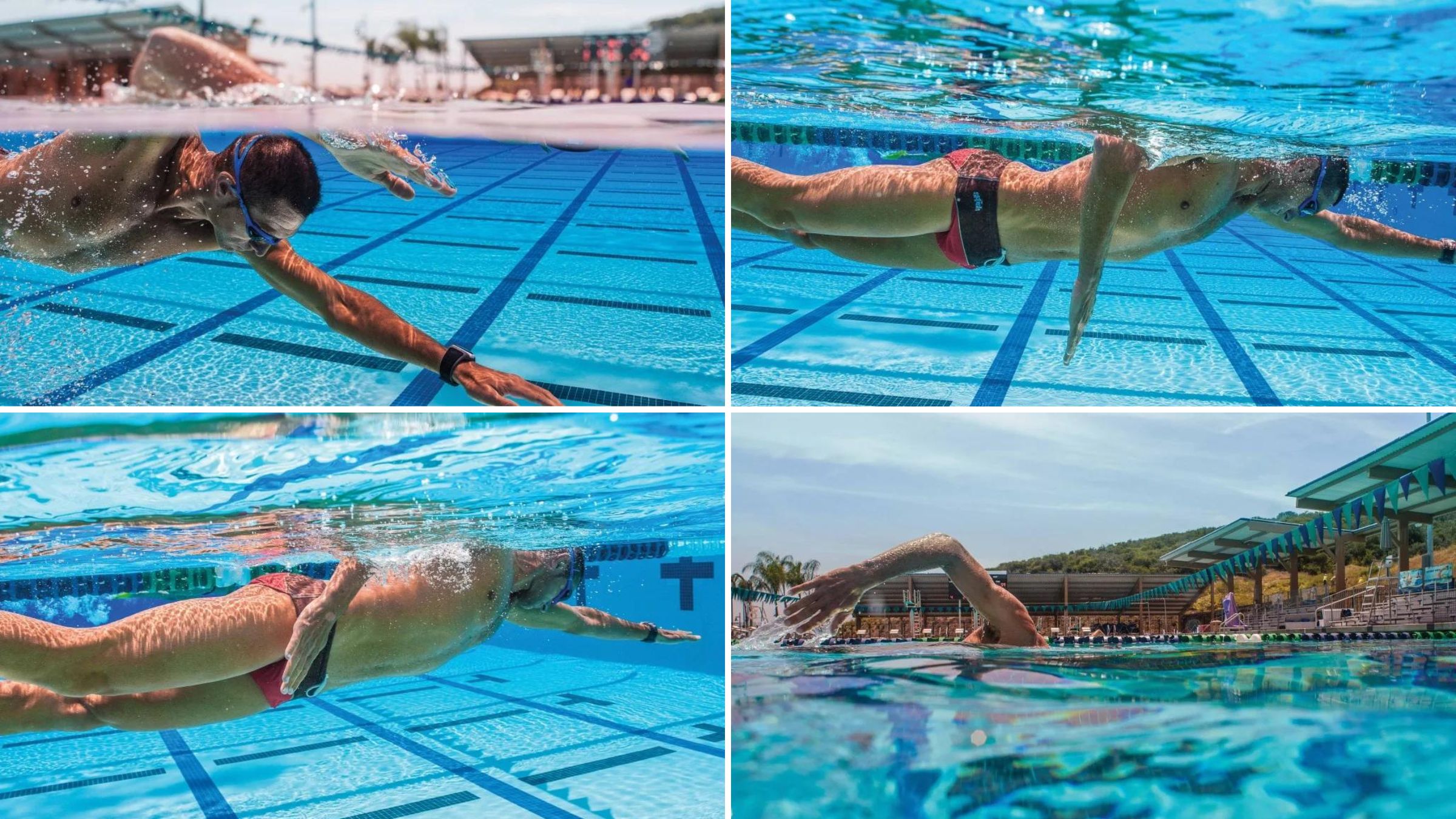
Learn the 4 phases of the swim stroke to improve your triathlon swimming. (Photo: Nils Nilsen)
Table of Contents
As anyone who has worked to improve their swimming can tell you, freestyle is complicated. All of your limbs are moving at different times and in different ways, you need to worry about breathing, and you need to stay on the surface of the water. However, just because freestyle itself is complicated, that doesn’t mean improving your freestyle needs to be complicated.While having an intricate understanding of every detail and nuance can be useful, what really matters is knowing what you need to do to improve. That’s going to ensure that you get the results you want with less time and effort.
This article will walk you through the main components of freestyle as simply as possible to help you understand the key pillars, and provide you with actionable advice that can be used to accomplish your goals. For each phase, I’ll describe the purpose of the phase, what you should aiming to accomplish, some common errors, and some straightforward solutions you can use to improve.
RELATED: A Complete Guide to Triathlon Swimming
Phase 1: The Catch

The “catch” is probably the most poorly named term in swimming Rather than “catching water,” the goal of the catch is to reposition your arm so that you can execute a great pull. When the hand first enters the water, it’s moving predominantly forward. However, to execute a great pull, you want the hand and forearm to face backward so you can create a big surface to move water backward with. The goal of the catch is to reposition the hand and forearm from a forward-facing position to a position that is pointed straight down. If you can get your fingers pointing down and your elbows pointing out to the side quickly and easily, you’ve established a great catch. Here’s what it looks like:
The most common mistake made during the catch is rushing through it. While it may seem like a good idea to immediately pull upon entry, it’s critical to properly reposition the arm first. Patience pays. Another common error that many make is to use a lot of side-to-side movement with the hand. Remember that the repositioning itself is quite simple, and you’ll want to minimize any extra motion.
ADVERTISEMENT
My favorite way to improve the catch is to use exercises that encourage the right movement. I like swimming with closed fists and holding paddles upside down. Either can be used during any swimming drill of your choice. Swimming with a closed fist encourages triathletes to get the hand and forearm pointing straight down so that the forearm can create propulsion to compensate for the smaller hand. The upside down paddle locks the wrist, which means that the hand and forearm need to be repositioned together, exactly what you want.
RELATED: The Best Hand Position For Swimming
Phase 2: The Pull
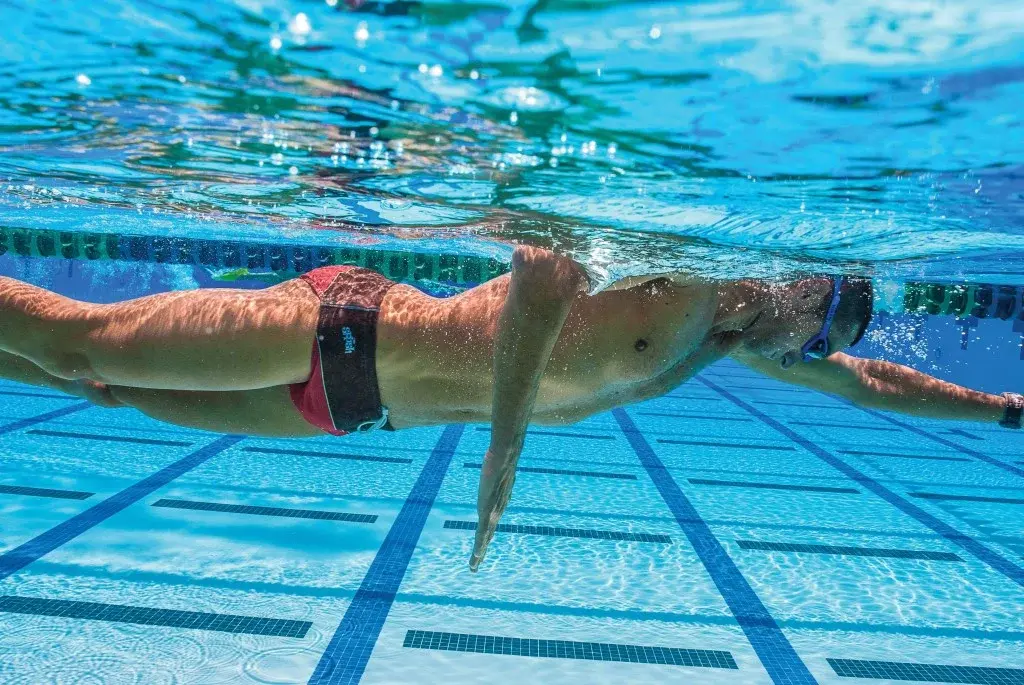
The purpose of the pull is to create propulsion by moving water directly backward so that you can move directly forward. When an effective catch is performed, the arm should be in a perfect position to move water backward. At that point, simply pull straight back. The arm may not move directly backward due to the anatomy of the shoulder, and that’s OK. However, the intention should be to pull straight back. A common mistake is to deliberately try to move the arm from side-to-side throughout the pull.
Another key aspect of the pull is to accelerate the hand throughout the pull. Once the catch has been performed and the arm is repositioned, it’s time to accelerate the hand back towards the feet. Many triathletes make the mistake of moving the hand at one speed throughout the pull. Really focus on accelerating each pull until it becomes a habit.
ADVERTISEMENT
A simple and effective way to learn the key skills of the pull is the combination of wall pull and power pulls with a buoy. For many triathletes, the sensation of pulling straight back from the catch position is a foreign one. The wall pull makes it very easy to create the appropriate positions and sensations, making it easier to properly execute these skills in the water. Power pulls are very similar to wall pull, except that they’ll be performed in the water. The focus remains the same, pulling directly backward and accelerating the hands throughout the pull.
RELATED: How to Choose the Best Swim Drills For You
Phase 3: The Finish
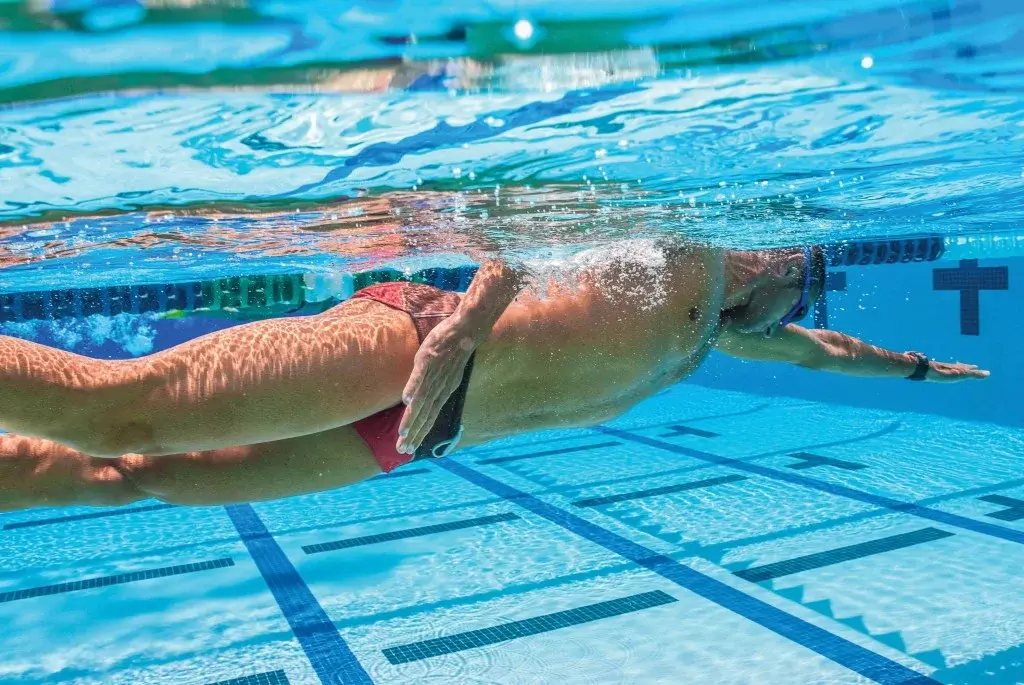
The purpose of the finish is twofold- it allows you to maximize the propulsion you create with each pull, and it creates the momentum need to effectively recover the arms. As we learned above, the hand should be accelerating towards the end of the finish. This high hand speed means more propulsion and it means the hand has a lot of momentum. That momentum is very useful for effortlessly swinging the hand into the recovery, as opposed to having to pull the hand through recovery.
The challenge is that the more you finish the pull, it becomes more difficult to keep the hand moving quickly into the recovery, even though this increases propulsion. And when you finish the pull short, it will be easier to transition the arm to the recovery, yet you’ll give up some propulsion. Trade-offs exists, and the specific trade-offs are different for each person.
ADVERTISEMENT
When aiming to figure out what finish works best for each individual, I suggest that triathletes deliberately explore a range of finishes rather than try to practice perfectly. During some repetitions, the goal should be to finish too short, and the goal should be to finish too long on others. As described above, the optimal length of the finish is determined by trade-offs, which will be slightly different for each person. By experimenting with a range of finishes, it’s more likely you’ll find what’s best for you. How do you know? If it’s faster, easier, or you take fewer strokes, you’re on the right track!
RELATED: Faster Swimming Can Be Simplified Into One Equation
Phase 4: The Recovery

The purpose of the recovery is to get the arm back to the front of the body so that you can create more speed by beginning your next pull. From this perspective, there are a lot of different ways to do so. However, there are some key points that need to be respected. As much as possible, the recovery should not take a lot of effort. It should swing freely, aided by the momentum of a greater finish to the stroke. Additonally, the recovery should be directly forward to ensure that the hand enters straight forward into the water. If the hands doesn’t enter straight, it can make it much more difficult to execute a great catch.
ADVERTISEMENT
A common mistake is swinging the arms low and to the side, which can cause problems with hand entries, as well as cause the body to wiggle side-to-side. To help triathletes learn to create an effective arm recovery, I like to simplify the freestyle motion and keep the recoveries underwater. It allows for a focus on very direct arm recoveries that set up a great catch. Here’s what it looks like:
Then, once progress has been made with the underwater recovery exercise, I like to begin to incorporate over-under freestyle, where one arm is recovered over the water and the other under. This keeps the same essential elements. These exercises have the bonus of improving the rotation of the body and the timing of the rotation, which makes it much easier to recover the arms effectively. These exercises tend to allow triathletes to find a natural recovery path that works for them.
RELATED: My Body Wiggles When I Swim. What Should I Do?
Put it all together: Freestyle phase swim workout
Below is a simple training session that incorporates all of these elements. To expand the workout, simply increase the number of repetitions, the distances of the freestyle repetitions, or the intensity of the freestyle repetitions. While keeping the same basic structure in place, the possibilities are limitless. If you want to focus on one aspect of the stroke, simply perform more repetitions of the desired skills.
100 Loosen; perform 10 second Ball Float before each repetition
Perform 1-2x
8×25 Freestyle; perform 10s of “Setting Up The Stroke”’ before each repetition
Alternate between 2 repetitions with Closed Fist and 2 repetitions with Upside Down Paddles
4×50 Freestyle; take 1 less stroke per 50
8×25 Power Pulls with a buoy; perform 10s of ‘Wall Pull’ before each repetition
ODD take as few strokes as possible EVEN build speed
4×50 Freestyle; take 1 less stroke per 50
ADVERTISEMENT
8×25 Freestyle;
ODD perform the finish too short, EVEN too long
4×50 Freestyle; take 1 less stroke per 50
8×25 ODD Underwater Recovery EVEN Over-Under Freestyle
4×50 Freestyle; take 1 less stroke per 50
Take 10-20 seconds between all repetitions