Updated February 17, 2026 05:49AM
If you buy through our links, we may earn an affiliate commission. This supports our mission to get more people active and outside.Learn about Outside Online's affiliate link policy
The Triathlete’s Guide to Run Power
Running with power could be the best way to not only know precisely what your effort is, but also how to make you a more efficient runner. We look at why and which devices work best.
(Photo: Coros)
Table of Contents
Technology keeps advancing endurance sports – both from a training and racing perspective, and we are seeing technology from one sport expand and progress into another endurance sport. Power meters in cycling have become so commonplace over the years that most cyclists and triathletes can speak to their best power outputs, threshold power values, and power zone ranges for workouts.
Cycling power turned a complex sport like cycling into something very simple, down to a single number. Even swimming has gotten in on the action with power meters you can wear to the pool. But what about power for running? Is power really possible to be measured, and what benefit does it have compared to the years of “tried and true” pace as the central metric?
What is power?
Before answering that question, let’s take a look at what “power” truly means: In general, power is a work rate, telling us how much work a person is accomplishing, over time, expressed as force applied, times speed of that force. On a bicycle this is expressed when an athlete pushes on the pedal and the crank arm with their leg, along with the cadence at which they apply that force. The number on a cycling power meter represents the amount of work accomplished in moving the bike forward – how fast it goes depends on the resistance it faces, affected by climbs, descents, surfaces, drafting, and more.
ADVERTISEMENT
It is important to remember that just because you apply a force to something, doesn’t mean it can move a distance, and in order for work to be accomplished, something must be moved by force. So if you push against a wall, and the wall doesn’t move, you’ve done zero work – when it comes to the formal definition – no matter how hard, taxing, and tiring the effort was when you applied the force to the wall. This is important because you still use energy in ways that are not efficient on a bike, that don’t provide any real force to move it. The power meter only shows what efforts are actually transferred to moving the bike.
Running with power: More than just effort
In running, we apply a force to the ground, with a cadence, that moves us through space, (Work!). Just like on a bike, the speed we are able to run at is dependent on a number of factors, such as uphill, downhill, terrain, and even wind (along with myriad physiological efficiencies and inefficiencies). However, while pace may vary on a course with a lot of up and down, an athlete can keep a consistent power (work rate), which is a much more efficient use of their energy, when running and racing, compared to pace.
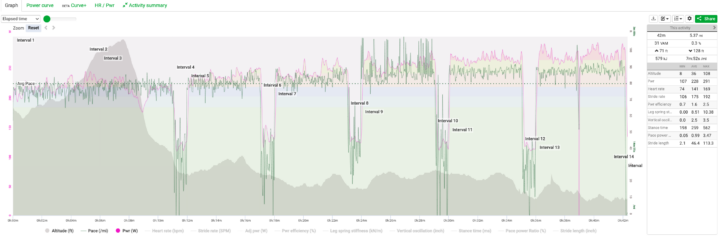
In this image, you can see where an athlete starts an overall downhill route, with a big climb at the beginning (shaded portion). In this run, the athlete is to build their pace over 5 minutes, with a 1-minute recovery jog, and each round of 5 minutes the pace is to get faster at the peak and overall for the interval. You can see the green line (pace) is increasing each round.
ADVERTISEMENT
In round three though, they suffer from some GPS reception issues (the other advantage of power meters is they’re not dependent on GPS), but as the run goes on, her run power increases a lot more than her pace does. In fact, she spent 64% of the run above her threshold power, but only 47 seconds above her threshold pace. This tells me, as her coach, that I need to consider adjusting her threshold power for the run or examine her form more closely as she runs faster, as there may be a lot of wasted movements to address.
This highlights an important fact – power relative to pace tells us how well we turn our biomechanics into running speed. There are a lot of movements we make that don’t actually propel us forward, like vertical oscillation of the head. Obviously, vertical movements don’t really help with forward movement, but if you don’t lift yourself off the ground, you can’t actually propel yourself running forward, so it’s a necessary inefficiency.
Now imagine your ability to measure these inefficiencies, and work to reduce them, or better yet, reduce them at the same time you increase pace, and you can see how a power meter can begin to help you.
ADVERTISEMENT
Does this mean pace doesn’t matter? No. In fact, pace matters most, because after all, we race to see who is fastest – not who works the hardest. But what power does give us is an enhancement of the metric of pace, letting us better understand how to produce a fast pace for the least amount of work required, and to help clarify our effort in changing conditions and courses.
RELATED: What is Power-to-Weight Ratio (and Why Does it Matter)?
How to use run power in training

The simplest and easiest way to use run power in your training is to simply get a device, and start recording your run power data over the course of three or more months. Observe the power outputs you produce while running easy, while walking, and while running hard, uphill or downhill. These general observations will give you an idea of what a potential threshold power value might be for yourself, as well as what intensities seem to line up with what paces and efforts. Look for any exponential changes in power relative to pace, and see if your perceived exertion is aligned similarly.
ADVERTISEMENT
Probably the best and most important thing you can do with your running power meter, is to record your race performances, and observe it during the race. Races are what you’re preparing for, so if you need to record and understand what the data says the demands of competition are for what you’re racing.
Post-race analysis with run power data provides a much clearer representation of whether your training matched the specific demands of the race. If you ran at much lower power off the bike than your race specific workouts, it is likely you trained at too high or too low of an intensity for your preparation (or your run failed because of nutritional or pacing issues on the bike).
And of course, all run courses are not equal, with some being 4-10% slower than others, simply based on elevation profiles, not even considering conditions. This only highlights the benefit of a power value to associate with run training and run performance. Power provides a much more fair comparison from race to race and course to course.
Using power to make adjustments
With a new, more consistent metric to normalize the efforts across multiple courses, terrains, and races, we can better compare training from one course to another, one location from another, race to race, and even season to season. Opportunities to better assess and perfect training for better race performances include:
- Perfect pacing strategies – When you know your power number to hold off the bike, it becomes both a governor early, and a carrot late in the race – regardless of how hilly the course is. When tested and strategized properly, this is likely the number-one benefit an athlete achieves.
- Reviewing race pacing off the bike – Did you hold an even power? Did you hold an even pace?
- Harder efforts can be better dialed in for maximum recovery – If your workouts are too intense, you increase the duration of required recovery. Holding a power number is a lot more predictable stress and load value on an athlete, than pace can be, and therefore less variability in fatigue levels.
- Progress training load and demands – Once you can define your run goals via power numbers, training progressions become much simpler to target and benchmark.
Run power presents an opportunity to take run training to the next level, and dial in race pace performances to better prepare and execute on race day. If you’re looking to make gains in your run, then run power is a relatively low-cost way to achieve the gains you’re looking for.
RELATED: Executing Your Race Strategy: The Run
Workouts for running with power

70.3-specific tempo with power
Step one: Take the average watts of your run for your last 70.3 race.
After a short warmup, do:
- (3 – 4)* x 10 minutes at that specific wattage number; 2-3 minutes recovery
- *Do 3 sets if you’re running off the bike as a race-specific transition run; do 4 sets if you’re doing it fresh
- Track how the pace improves with the same watts, over the course of 4-6 weeks.
ADVERTISEMENT
Aerobic threshold power run
If you have established a threshold heart rate or pace value at your aerobic threshold – either LT1 or LT2 – then run at that power for a 40-60-minute tempo, and later come back and try the same. Tracking the power value from workout to workout can provide specific details of improvement in economy. For example, if you stayed at the same pace and HR, but saw a lower power, this shows an improvement in economy.
How to measure running with power
In running, it is very difficult to directly measure power, given the torsional aspect of forces applied through the foot during landing and propulsion, but with many advances in wearable technologies, algorithms to accurately estimate and record these movements and power calculations has helped to make power much more available and accurate. The different ways power is calculated are based on the type of device and are generally categorized as one of three:
- Footpod – worn on the shoe
- Watches – worn on the wrist of the runner
- Insoles – worn inside the shoes
Which of these is more accurate? It’s very difficult to say. Which one is more popular? Built-in power measurement on smartwatches is now nearly ubiquitous, though footpods are also still available and often provide more advanced data collection and processing.
One thing we can say for sure, if an athlete is using run power data, then the best practice is to be consistent with the device you use. If you’re planning to jump from different brands and/or types of devices (i.e., wrist watch to footpod, or vice versa), then data from one device or brand is not likely to be accurate or easily converted for future analysis or comparison purposes with another device. The algorithms are just too different, although some might find the trends to be consistent and similar.
ADVERTISEMENT
Take a look at Triathlete’s editor-in-chief, Chris Foster’s, top picks below:
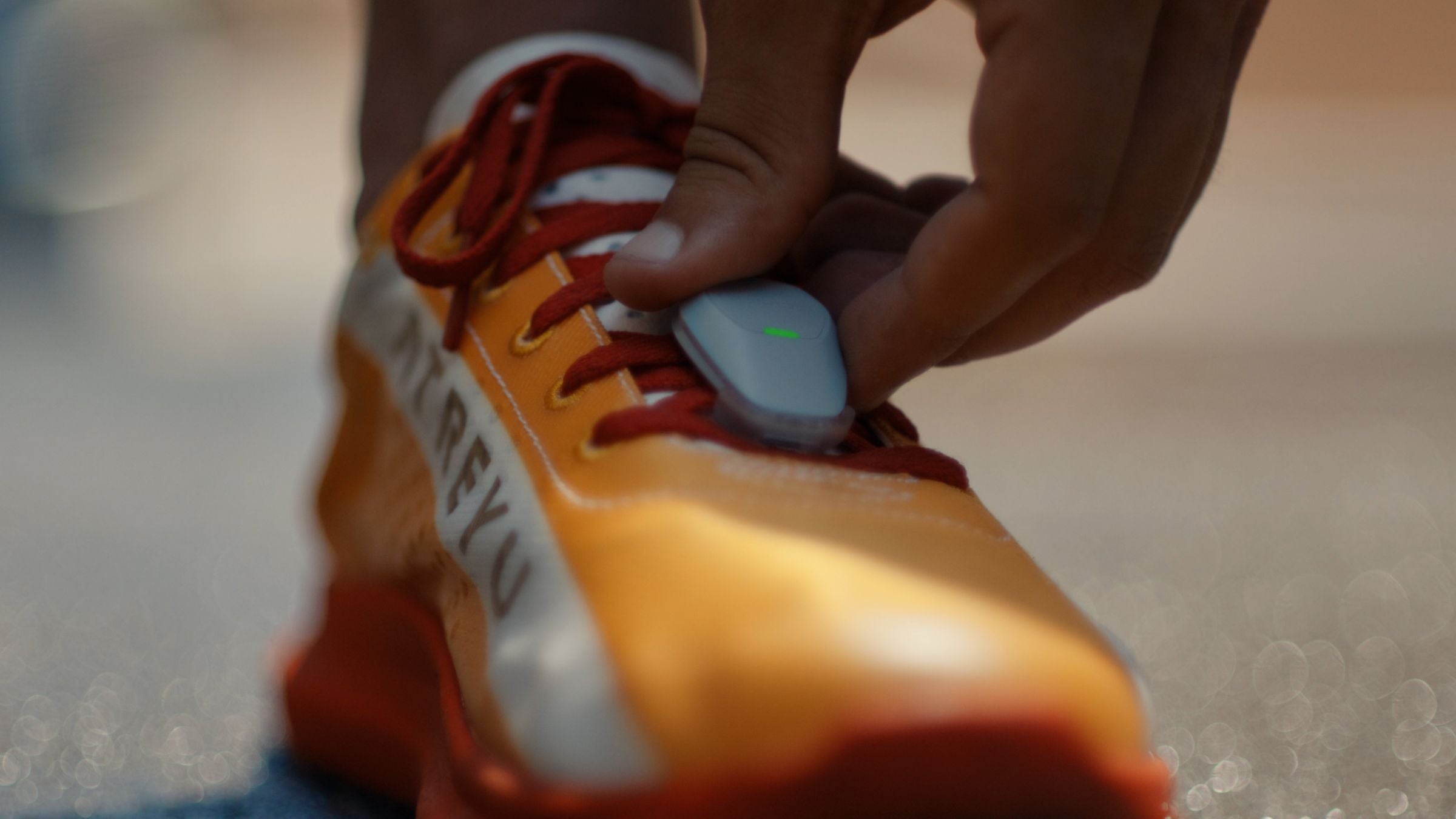
Coros Pod 2

This update to Coros’ original footpod helps improve smartwatch accuracy outdoors and provides metrics when running indoors (like the Stryd). Also like the Stryd pod, this device gives more advanced dynamics than you’d typically find in an on-wrist device – metrics like ambient temperature, Ground Contact Time (GCT), Left/Right Balance, Stride Height, and Stride Ratio. Oddly, Coros has moved away from the “running power” terminology and now uses “Effort Pace” – a min/mi metric that’s more familiar to more runners – but the result is about the same.
ADVERTISEMENT
The good news is the Coros device is one-third of the price of the Stryd, and while it doesn’t have quite the depth of data (nor as robust of a training/logging/data analysis platform), it’s almost the exact same size as the Stryd and can be worn either on a shoe or on the waistband of your shorts. The bad news is that Pod 2 is only compatible with Coros smartwatches, so unless you already have a Coros device or are planning on getting one (and want to upgrade the built-in dynamics capabilities), it doesn’t make a ton of sense.
Stryd Footpod 5.0
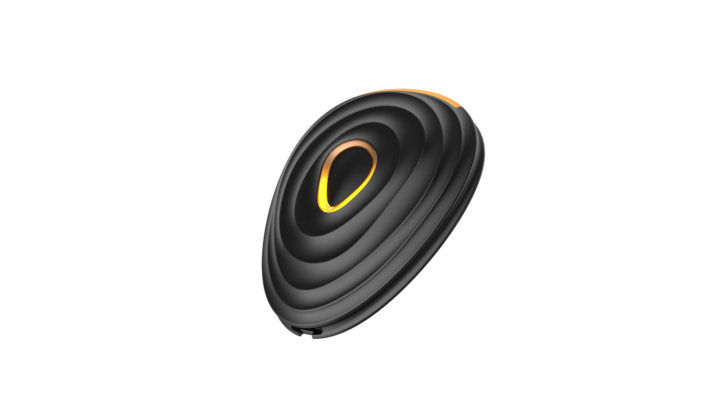
Stryd was one of the first brands to really focus on running with power, and it’s no surprise that they’re also by far the most accurate and comprehensive when it comes to running dynamics. Along with ANT+ and BLE-connected running power metrics, Stryd also does even more advanced data collection like Form Power Ratio (FPR), Ground Contact Time (GCT), Vertical Oscillation, Leg String Stiffness (LSS), and wind detection (to quantify the impact that wind has on your effort). The newest version is substantially more responsive – meaning it’ll register quicker changes in power on workouts with short bursts and/or quick recovery – as well as Impact Loading Rate (to calculate stress).
ADVERTISEMENT
The good news with the Stryd is that it’s compatible with Garmin, Polar, Coros, Suunto, Apple, and more, and even if you don’t have a compatible smartwatch, Stryd will record the data and sync to the smartphone app for post-run analysis (though of course you won’t be able to see your metrics in real time). The bad news is that it’s $300 (without a membership) in addition to a smartwatch purchase, and much of the data is overkill for most athletes – especially triathletes who might already be literally swimming in data.
Coros Pace 4
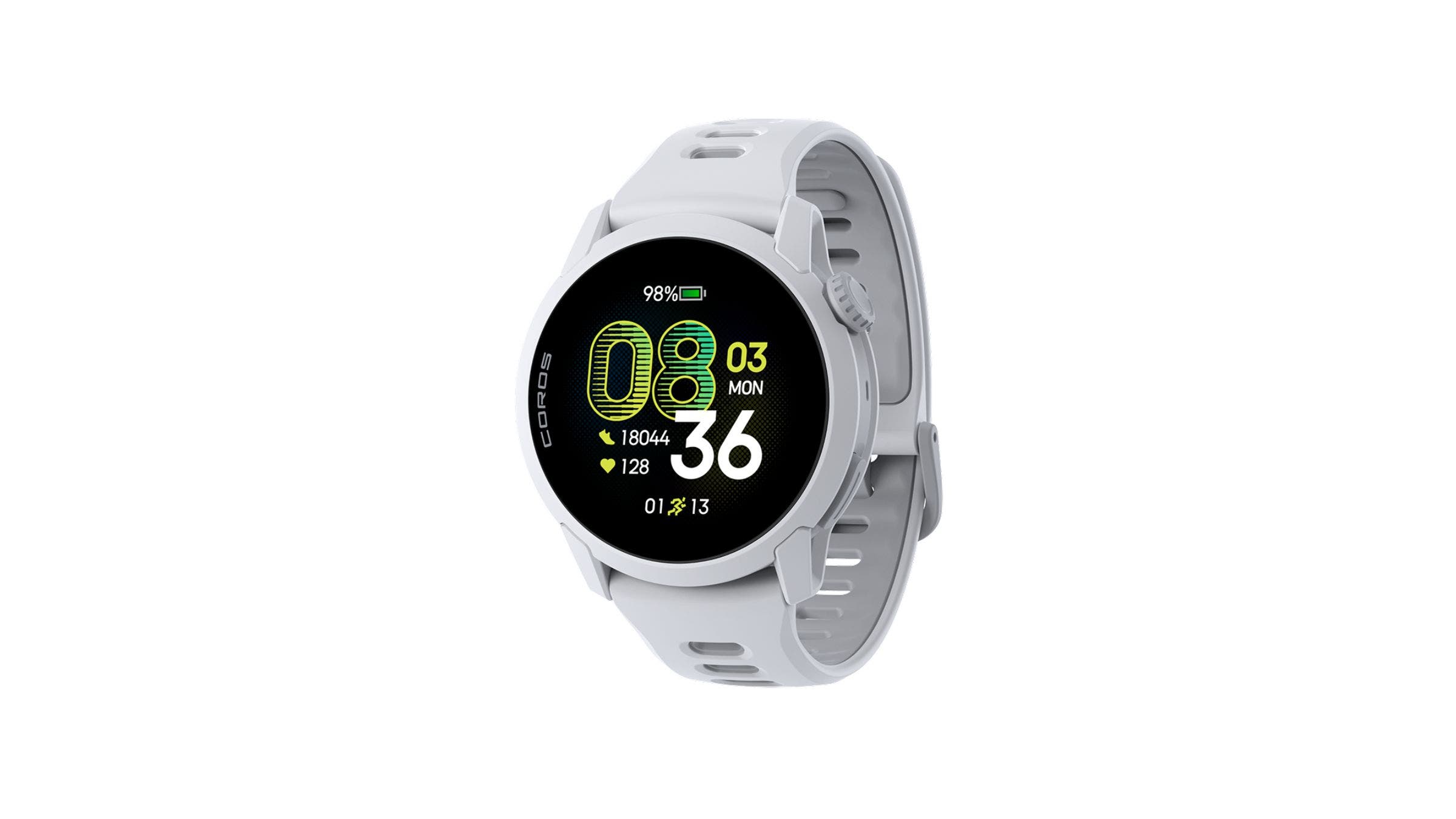
Yes, we’ve already included the Coros footpod in this roundup, but the realty is that 90% of triathletes will likely forego a footpod in favor of a reduced device footprint and simply use the running with power measurement from their smartwatch. If you don’t already have a smartwatch with built-in running power measurement (it would have to be an older watch at this point), and you don’t want to spend a ton of cash, there is literally no better smartwatch on the market – in terms of bang for your buck – than the Coros Pace 4.
While the Pace 4 obviously has built-in running with power measurement (all Coros watches do), for $250 you’ll struggle to find a more robust smartwatch with a clear, bright AMOLED touchscreen and remarkably decent battery life (8-10 days real-world use; 24 hours all-on GPS). Though it doesn’t have built-in mapping, when paired with the Coros smartphone app, you can extend the watch’s screen to your phone and use the built in mapping/navigation in real time while running. If there’s one downside to the Pace 4, it’s that it can feel a little bit like a toy and probably not something you’d wear to the office or out for post-workout drinks. If you’re looking for something more stylish with built-in running with power, definitely consider the Suunto Run, another fantastic $250 smartwatch with weaker battery life, but (subjectively) nicer looking.
ADVERTISEMENT
Suunto Race 2
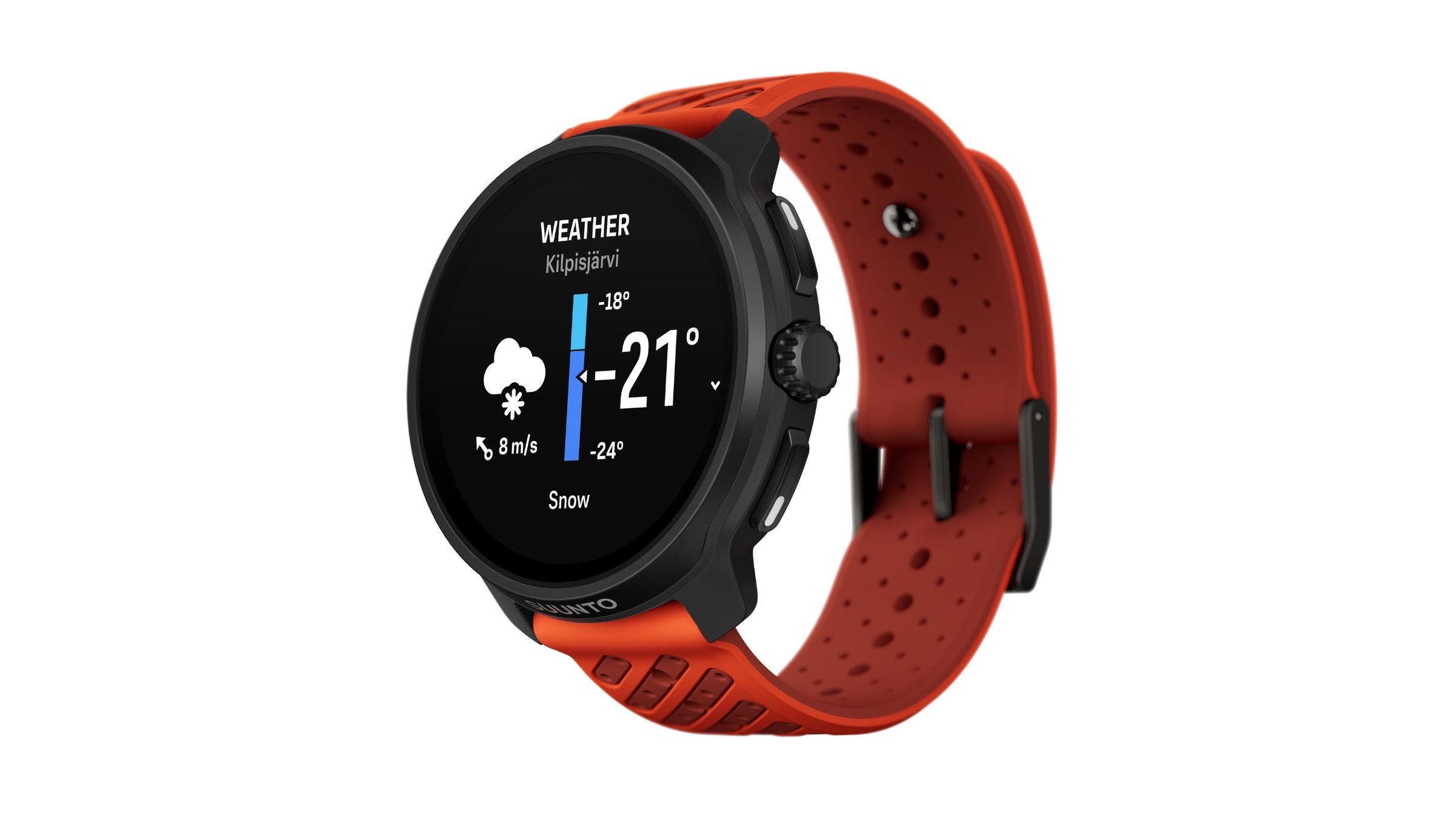
As good as the Coros Pace 4 is, if you’re looking for a smartwatch with excellent built-in running with power measurement, plus a bigger (and prettier) screen, onboard mapping, and more all-day styling, the Suunto Race 2 is the best choice for a midrange, $500 smartwatch.
We love the bulletproof steel watch body and the big, super-bright screen (we actually had to turn ours down in testing), along with the top-shelf mapping and smartphone app route creation. That said, battery life wasn’t super impressive for triathletes who will likely get about a week of real-world battery life if you’re training once or twice per day, but if you can remember to charge it every few days, that won’t be an issue.
ADVERTISEMENT
Garmin Forerunner 970
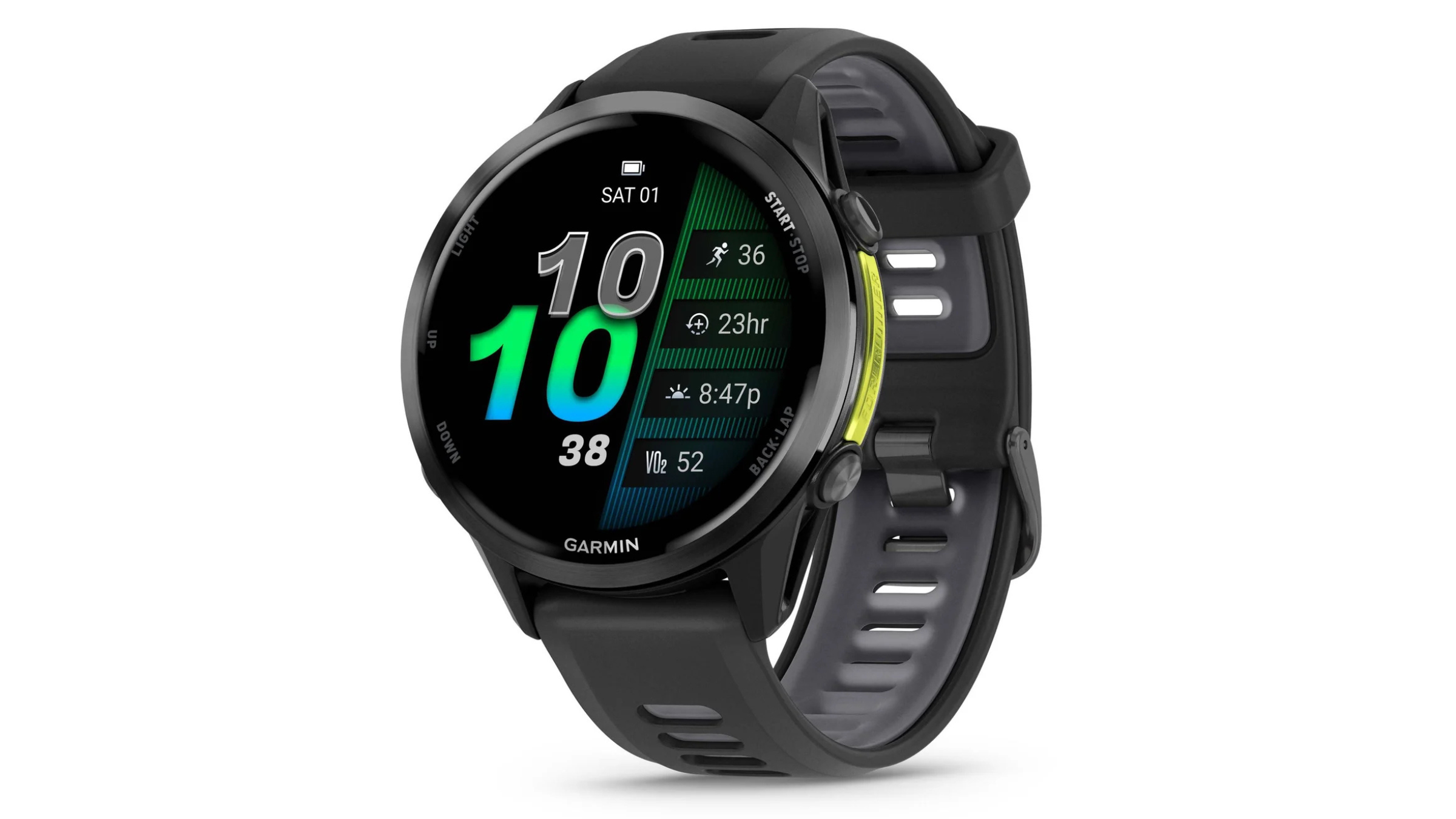
If you’re looking for a all-the-bells-and-whistles smartwatch with built-in running with power measurement, then you’ll likely love the Garmin Forerunner 970. The Forerunner 970 boasts a respectable 15 days of everyday battery life with a super-bright and big AMOLED touchscreen, built-in mapping, and online music (most importantly, built-in offline Spotify music, which is unique to the Garmin ecosystem – worth noting if you like to play music but don’t have a pile of mp3s just lying around on your computer).
For triathletes who train early or late in the day, the Forerunner 970 also crucially has an excellent built-in LED flashlight, on the level of a smartphone flashlight (except it can be used hands-free on your wrist). This means no groping around in the dark for your gels in a predawn transition area or as you creep out of the house early for your Masters swim.
ADVERTISEMENT
The only downside with the 970 is the fact that while $750 gets you a pile of physiological features around sleep tracking, HRV, and training/race readiness, there’s a good chance that most triathletes will barely scratch the surface of all of these features. So read our full review carefully to make sure you’ll get the most out of this kitchen-sink smartwatch with built-in running with power measurement.