Published May 13, 2009 01:47PM
Beginner Triathlete: What You Need To Know For Your First Race-Day Swim
Swim coach Kevin Koskella helps to ease those pre-race swim jitters by answering commonly asked questions from beginners.
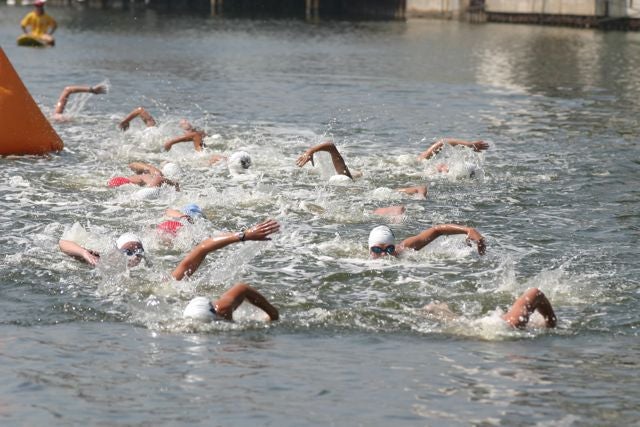
Learn more about the basics of your first race swim. Photo provided by Spomedis/ Triathlon.org.
Q: Should I wear a wetsuit?
A: It depends on whether or not wetsuits are allowed in the race. Most of the age group races allow wetsuits. In this case you should definitely use a wetsuit! You will not only be able to withstand the cold water, but you will also be given the gift of buoyancy. Buoyancy will make it quite a bit easier to get through the swim.
Q: Can I swim another stroke besides freestyle?
A: Yes. Although freestyle is the fastest and most common stroke in triathlon, beginners may benefit from occasionally doing a few strokes of backstroke or breaststroke to regain their breath.
Q: Where should I line up at the beginning of the race?
A: Stay towards the back and to the outside. Unless you are a strong swimmer, starting in the front of the pack will likely result in you getting clobbered. The last thing you want to do is lose more energy fighting against the conditions. You are better off finding clean water and taking the first buoy a little wider.
ADVERTISEMENT
Q: Should I use a heart rate monitor?
A: If you are used to using a heart rate monitor when you train, it may help you at certain points in your rate. In some situations, like transitions, it is good to keep your heart rate from getting too far out of whack. When it comes to the swim, it will be impossible to look at your watch and keep track of your heart rate.
Q: How often should I “sight”?
A: The first thing you should do is find out how many buoys there are and learn the course. This will limit the number of times you need to pop your head up to see where you are. Ideally you should find an object, like the next buoy, to focus on when you lift your head up. Otherwise, taking a peek every six to eight arm cycles should be adequate.
Q: How often should I breathe during a race swim?
A: Don’t get hung up on this if this is your first race. Breathe when you need air, even if that means every two strokes. As you get a race or two under your belt, learn to breathe bilaterally. This will help with navigation and help you to swim in a straight line.