Updated July 9, 2025 06:23AM
How To Fuel For Your First Triathlon
Read on for what to eat the night before your first sprint triathlon, the morning of your race, and during the big event itself.
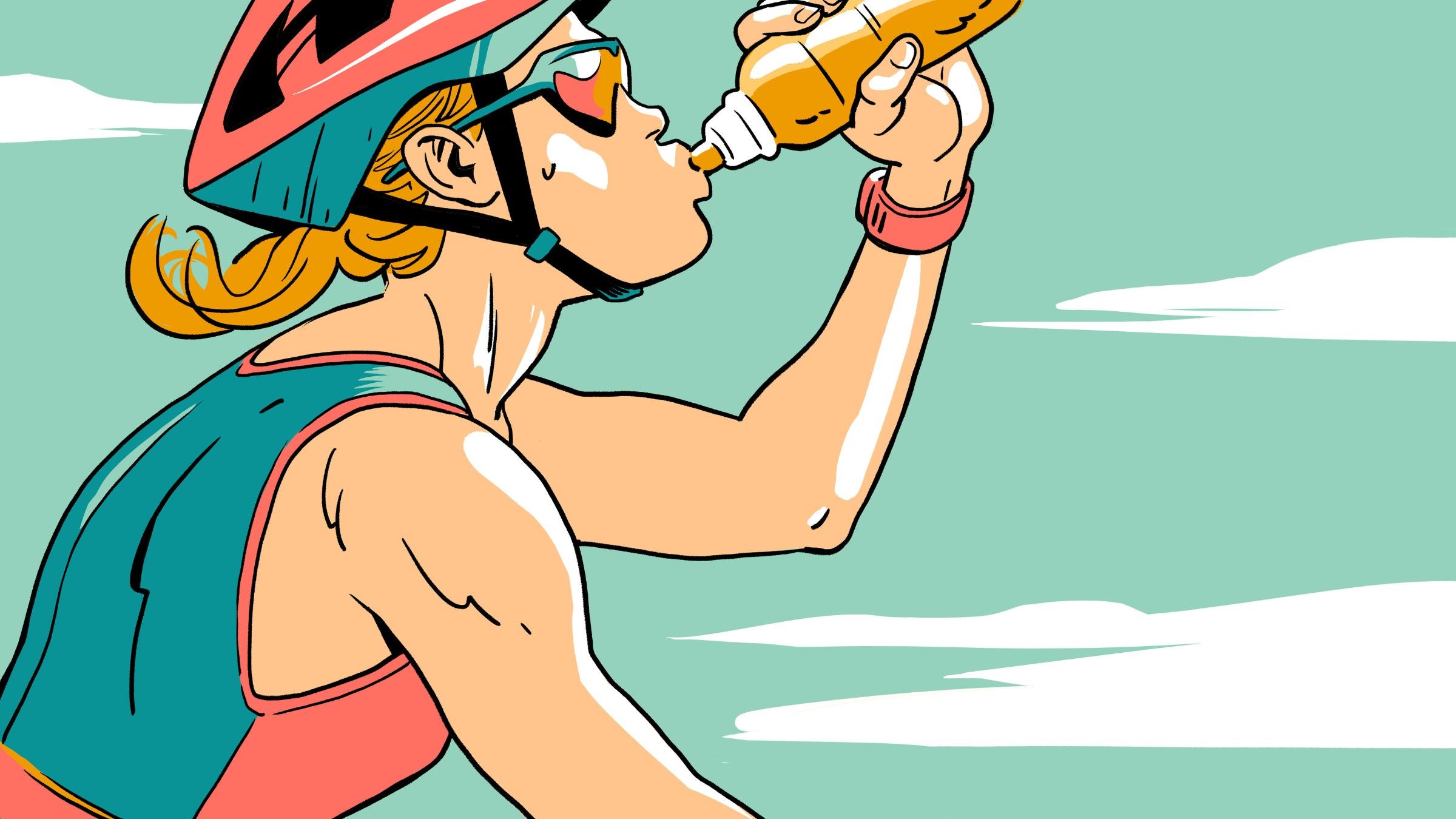
(Photo: James Boyle)
It’s been said that triathlon has four disciplines: swim, bike, run, and nutrition. And if you’ve ever been out for a workout on a hot or long day and ended up crawling back to the car, you’ve experienced first-hand that an athlete is only as good as the engine within. You’ve got to feed that engine some quality fuel! This is particularly true when it comes to determining what to eat for your first triathlon race.
In training for a sprint triathlon, you’re doing most of your swim, bike, and run workouts separately. On race day, when you put the three together without extended breaks, sports fueling becomes even more important to support performance, avoid gastrointestinal (GI) issues, and recover from your effort. Rest assured, we know race day – three sports, with all the equipment, two transitions, and fueling/hydrating – can be overwhelming. But having a step-by-step guide to fueling for your first sprint triathlon can make things a lot easier. We’ve got you. Read on for what to eat the night before your triathlon, the morning of your race, and during the big event itself.
RELATED: Triathlete’s Guide to Your First Triathlon
ADVERTISEMENT
What to eat the night before your first triathlon
The last meal of the pre-race day is for topping off glycogen stores and staving off fatigue while reducing the possibility of gastrointestinal (GI) distress. Feel free to eat to your satisfaction, but avoid stuffing yourself to the brim. Plan your pre-race meal for at least 2.5-3 hours before bedtime so you don’t lie down with a full stomach, as digestion can sabotage your much-needed sleep.
Your pre-race meal should resemble a typical dinner on any ordinary evening before a key training session. Pay attention to what works for you in training – did eating pizza the night before a weekend run help you feel strong the next day? If so, you’ve found your pre-race meal. Whatever you choose, dinner on the night before your triathlon should be rich in easy-to-digest carbohydrates, low in fat and fiber, and moderate in protein. Avoid spicy foods, fried foods, carbonated beverages, uncooked meat, and unfamiliar foods. Pre-race is not the time to be adventurous with food; save that for the post-race celebration.
Pre-race triathlon dinner examples
Choose one. Add salt to taste.
- White rice, grilled chicken, side salad, dinner roll, water
- White or sweet potato, grilled chicken or lean steak, steamed green beans and carrots, dinner roll, water
- Cheese pizza, side salad, water
- Pasta with a marinara sauce, lean protein of choice, and steamed veggies (low in fiber); avoid broccoli.
ADVERTISEMENT
Tips for your pre-race meal
- Plan to test drive your pre-race meals and sports nutrition plan repeatedly during training in race-like temperatures to avoid any race-day hicccups.
- Eat an early dinner, at least 2.5-3 hours before bedtime, earlier, if possible, to optimize a good night’s sleep.
- Enjoy your meal until you are satisfied, but avoid stuffing yourself.
- Establish a “ritual” dinner in training that can be re-created on the night before race day. Having a familiar meal can calm pre-race anxiety and put you in the right mindset.
- Avoid drinking too much water. Over-hydrating will have you running to the bathroom unnecessarily, dilute your bloodstream of valuable electrolytes, and interfere with sleep.
- Although a glass of wine or a beer may be part of your nightly routine, alcohol, even in small amounts, can negatively affect sleep, hydration status, motor skills, judgment, and overall performance.
RELATED: Beyond Pasta: The New Rules of Carb Loading
What to eat the morning of your first triathlon
You may not be a breakfast lover, but intentionally skipping breakfast on race day is ill-advised. Research shows that eating before a race-specific workout or competition improves performance. Here’s why: during the night, liver glycogen is responsible for maintaining blood sugars and fueling the body’s work of repairing and rebuilding from the previous day’s efforts while you sleep. By morning, your liver glycogen is low – think of a car with only a gallon left in the gas tank. It will only go so far until it runs out. Therefore, taking in some fuel – in this case, carbohydrates – will boost blood sugar and liver glycogen and offset fatigue. But you don’t need to eat a five-course breakfast. When it comes to your pre-race meal for a sprint triathlon, a little can go a long way.
Aim to have breakfast 2.5-3 hours before the race starts, to allow plenty of time for digestion. If pre-race jitters get the best of you, try taking small bites and slowing down, or for those who struggle with eating that early in the morning, take your breakfast in liquid form since it will clear the gut faster than solids and provide hydration. (Smoothies can be your savior here!).
Breakfast should be mainly carbohydrates, low fiber with a small amount of protein, and very little fat, since fat takes the longest to clear the gut and can lead to GI issues.
ADVERTISEMENT
Whatever you do, remember: nothing new on race day. As with the pre-race dinner, test-drive your pre-race breakfast repeatedly in training.
Race day breakfast examples
Choose one:
- Bagel, 2 Tbsp jam, 2 Tbsp nut butter, one banana, water, and coffee or tea
- One cup cooked oatmeal, one banana, 1 Tbsp honey, small Greek yogurt, water, and coffee or tea
- 20-24 oz sports drink sipped over a few hours (30-40g carbohydrate/bottle), 1-2 pieces of toast, 2 Tbsp nut butter or jam, 1 cup applesauce, water, and coffee or tea.
- 1-2 waffles with maple syrup, 1-2 eggs or 2 Tbsp nut butter, side of fruit (avoid apples as they are prone to causing gas during activity).
What if I’m too nervous to eat before my race?
When breakfast does not go down easily on race morning, don’t worry, you have up to 20 minutes before the race to top off blood glucose. Depending on when you can eat – choose one (not all) of these refueling guidelines below:
- 90 minutes out from the race start: Aim for a 12-oz sports drink and ½ sports bar or energy chews. You want to shoot for 1.5 grams of carbohydrates per kg body weight (1kg = 2.2 lbs.)
- 60 minutes out: No more than 1 gram of carbohydrate per kg body weight.
- 20 minutes out: No more than 20-25 grams of carbohydrate.
Examples of pre-race carbohydrate sources:
- 8-12 oz. sports beverage
- Energy chews (20-50g carbs; 20-60 min out)
- 100 calories of sports supplement fuel
RELATED: Dear Coach: Do I Really Need a Race Morning Ritual?
ADVERTISEMENT
What to eat during your first triathlon
Your pre-race meal should carry you through the short swim of your race just fine, so don’t worry about fueling until you get on the bike. That’s when you’ll need to start eating during your triathlon.
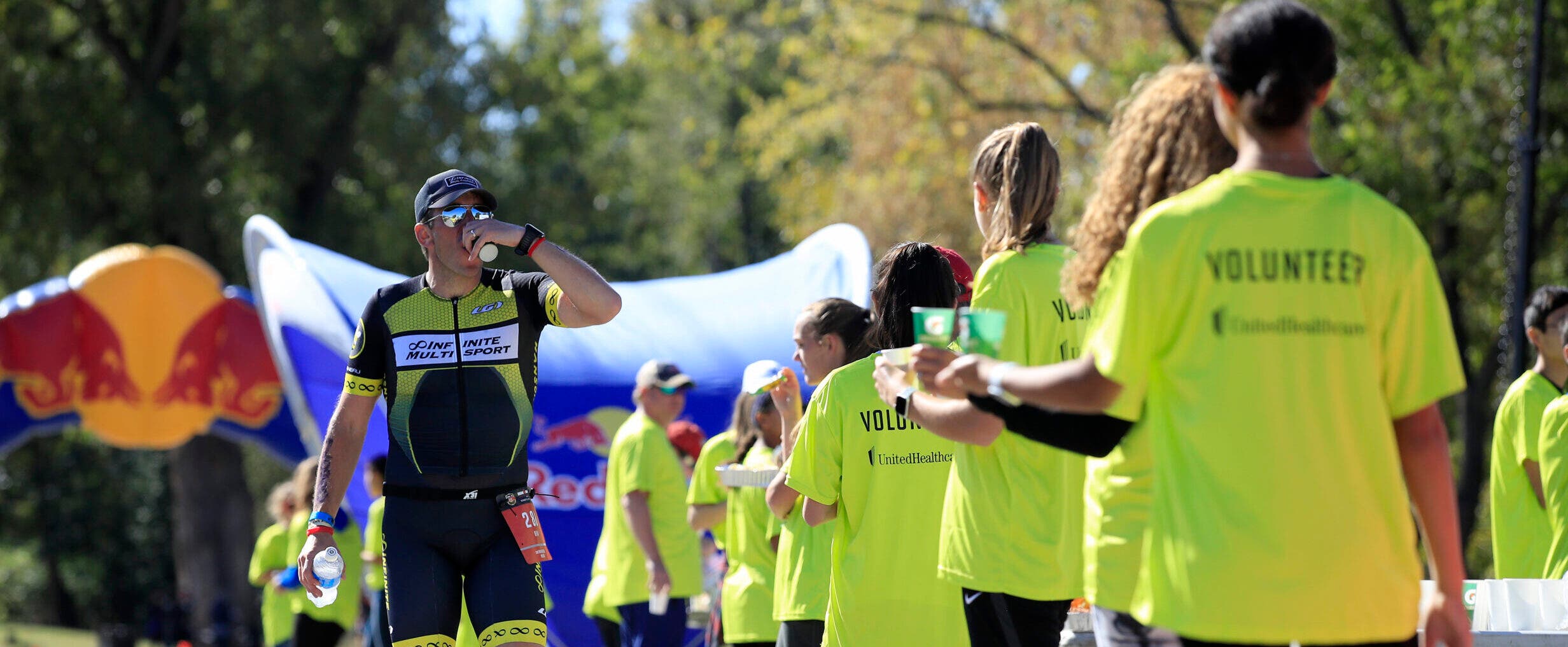
To prepare, it’s a good idea to familiarize yourself with the swim, bike, and run course maps before race day. This will help you identify where the bike and run aid stations are on the course, and what is being offered. You can usually find this information on the race website, in the athlete guide, and/or in any emails sent out by the race director. You may also find a map of the course during the race expo when you pick up your bib number. If you can’t find the information anywhere, email the race director (you should be able to find a contact on the race website) or ask a volunteer.
What to eat during the bike leg of a sprint triathlon
Not all sprint triathlon races will have an aid station on the bike course. But even if your race does have an aid station, plan to carry at least one 20-28 ounce bottle on your bike, filled with a familiar, well-formulated sports drink of your preference. The ideal sports drink should contain a mix of sugar sources (glucose, sucrose, fructose, or maltodextrin), sodium, chloride, potassium, water, and 10-14 grams of carbohydrates per 8 ounces. The sodium content should be at least 120 mg sodium/8 ounces to enhance the taste, stimulate drinking, facilitate absorption, and maintain body fluids/blood volume.
ADVERTISEMENT
RELATED: How to Choose the Best Sports Drink for Triathlon
During your race, start sipping from your bottle as soon as you safely navigate into the flow of race traffic from T1. It takes a little while to absorb calories, so begin fueling/hydrating well before you need it. Aim for 2-4 gulps on the bike every 6-10 minutes to ensure you are adequately hydrated and fueled for the run.
Pro tip: Take the time in training to become comfortable drinking while riding, as it saves time and is less hectic than navigating bike traffic to stop on the side of the road to sip from your bottle.
What to eat during the run leg of a sprint triathlon
Triathlon run courses usually have at least one aid station over a 5K distance. But all races are different, so don’t assume. Expect water at a minimum and perhaps a sports drink specific to that race. Some races offer cola and ice, while others do not. Depending on your fitness and comfort level with the distance, and the temperature/humidity, consider using the run aid stations for a quick intentional walk break to unload and rehydrate. This is a case of when slowing down actually makes you faster. And the more you can offset dehydration, the better your performance. Aim for 3-5 gulps of fluid, then resume running. The hotter the climate, the more fluids you will need.
ADVERTISEMENT
Do I need caffeine during my first triathlon?
If you are a regular caffeine consumer and want to use it on race day, treat it like everything else you’re taking in on race day: practice it in training first! Use caffeine in your workouts over and over again to dial in the right timing and dose to ensure you have the desired outcome on race day.
Caffeine’s most notable benefit is its effect on the brain; it stimulates the central nervous system, decreases the perception of work and delays fatigue, and improves mental acuity and the ability to remain mentally present. Contrary to popular belief, it will not allow you to do superhuman things if your body is tired, under-trained, or under-fueled. If you are sensitive to caffeine and experience adverse side effects, it’s not for you, and that’s just fine, too.
How to implement caffeine into your race plan
Caffeine has been shown to enhance performance, but as with all things, more is not better. Research suggests a dose of 2-3mg/kg body weight improves performance, and doses higher than 5mg/kg do not yield greater performance benefits. In fact, taking in too much caffeine can cause gastrointestinal distress, which is the last thing you want to experience during a race. The best approach is to shoot for the lowest amount that supports performance – again, dial this in while you’re training so you know exactly what you need on race day.
Caffeine takes 45-60 minutes to absorb into your system, so plan to take it well before you hope to enjoy the effects. Caffeinated products include coffee, tea, soda, and caffeine-added sports nutrition products, such as Bloks, chews, chomps, and gels. The best times to take caffeine are in the pre-race morning meal/snack and before the swim. Caffeine consumed on the run is too late as it won’t take effect until you have crossed the finish line.
ADVERTISEMENT
RELATED: 10 Things The Latest Science Tells Us About Caffeine and Athletes
Just as you train to prepare your body for the task, train your gut to digest the fuel you plan to use on race day. Use training to figure out what works best for you, then repeat it over and over. Above all else, don’t let the shiny new products at the race expo sway you, or what your neighbor in transition is wearing, eating, or doing. You do you, and commit to the golden rule: Nothing new on race day!