Updated July 10, 2025 02:25PM
Triathlon News & Notes: Blummenfelt Eyes Kona for this Fall, A Tokyo Robot, and IM Australia Canceled
A look at some of the news we’ve picked up in the sport over the past seven days.
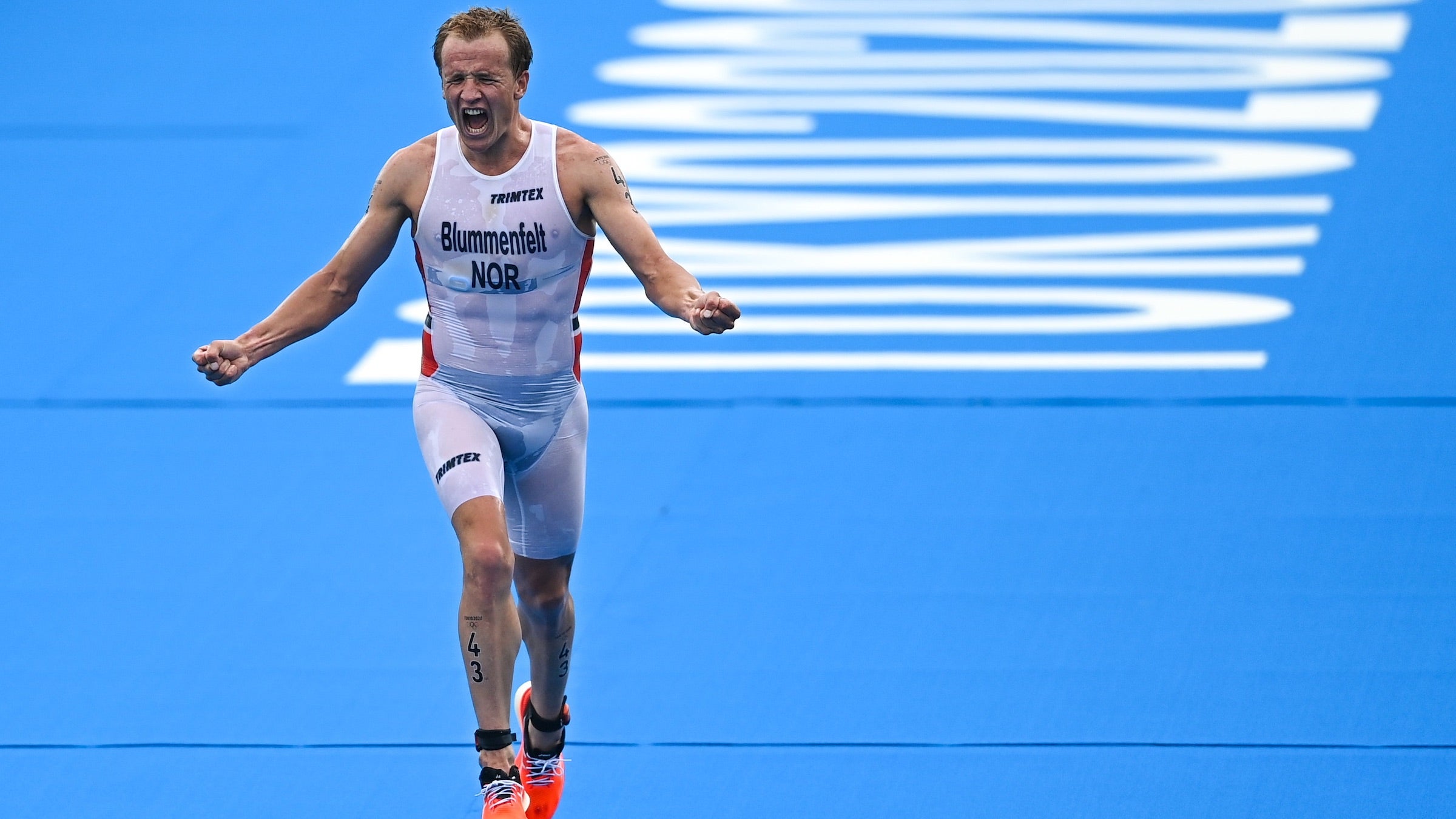
(Photo: Photo By Ramsey Cardy/Sportsfile via Getty Images)
Maybe the biggest news of the week was buried in a post-Olympics podcast. Read all the way to the bottom.
Canada’s Tyler Mislawchuk out for Canada’s mixed relay
Team Canada will be without their ace Tyler Mislawchuk in the mixed relay event. Earlier this week, Mislawchuk, 27, posted, “I have been informed from the medical team here [that] I will be unable to race due to [the] severity of an Achilles injury I have. Something that was hard not to talk about after the individual race and was one of the reasons I am so devastated.” He also confirmed that Alexis Lepage, who did not compete in the men’s individual race in Tokyo, will replace him on the relay. Mislawchuk isn’t the only big name to drop from the relay field; on Tuesday, embattled South African star Richard Murray posted that his country’s team had to drop from the event after Henri Schoeman was diagnosed with a stress fracture, later announcing he was staging his own triathlon in Tokyo’s Olympic Village on Saturday.
Tokyo triathlon’s rainbow moment goes mainstream
One of the sweetest stories to emerge from the Tokyo Olympic triathlon was the presence of a rainbow during the race—and its significance to Team USA star Katie Zaferes. The 32-year-old, who won the bronze medal on Monday, said the spectrum was a sign from her dad, Bill Hursey, who died suddenly in April. “I just gave a little, ‘Hi, Dad.’ I just felt like that was him. I felt him,” Zaferes said after the race. “I feel like he’d be so happy.” The feel-good sentiment—and Zaferes’ ability to race so well despite her grief—was picked up by mainstream media, including a live appearance on the Today show.
ADVERTISEMENT
Blummenfelt’s Olympic uniform generates buzz
Another topic that created buzz this week: Gold medalist Kristian Blummenfelt’s team Norway uniform. Specifically designed with a lightweight fabric to beat the heat and humidity of Tokyo, the mostly-sheer white uniform featured a black “privacy panel” that looked like a boxy black speedo underneath. When Blummenfelt charged to the finish line for the win, all eyes at home were on him—and his see-through kit. The look generated viral chatter on social media, with some people comparing it to “Captain Underpants” and outlets even calling the look as a “bizarre wardrobe malfunction.” For his part, Blummenfelt said the uniform was all part of a highly-calculated plan to stay cool in the predicted record-high temps, and that he was actually bummed it wasn’t hotter on race day. “Our staff pushed to have the best possible suit even though we know it would be see-through,” he said. “We knew it would be worth it.”
Michael Douglas gives Flora Duffy a shout-out on Instagram
No doubt, Bermuda’s Flora Duffy’s inboxes and social media mentions were overflowing after her triumphant win in Tokyo earlier this week. But perhaps the most notable shout-out came from Hollywood actor Michael Douglas, who posted a video to his 928,000 Instagram followers dedicated to congratulating Duffy. Douglas has a special connection to Bermuda, Duffy’s home country, as his mother was born there, and it is where he and wife Catherine Zeta-Jones own an estate.
ADVERTISEMENT
Tokyo robotic unicorn on full display during triathlon
If you watched the Olympic triathlon and were wondering about the story behind the giant robot-like statue looming over the course, here’s your answer: It’s the RX-0 Unicorn Gundam, a six-story “mobile suit” plucked from a popular Japanese anime franchise of the same name. Permanently parked outside of the DiverCity shopping mall in Odaiba, that statue is also the site of a daily light show, where it “transforms” from Unicorn Mode to Destroy Mode for onlookers.
Israeli brothers pair up to make history in Olympic triathlon
Team Israel may not have medaled at the Olympic event, but two members did stand out as the only siblings to compete together in the race. Shachar and Ran Sagiv finished 20th and 35th, respectively, in last Sunday’s event. Not only are they the second and third Israeli Olympic triathletes in history, but Shachar’s finish was the highest-ever for the country. And while they may be the first set of siblings to compete for Israel in Olympic triathlon, they aren’t the first Olympians in their family: Their father, Shemi “Sabag” Sagiv, competed in the marathon at the 1984 Games in Los Angeles.
Zwift offering PTO Collins Cup series
After the Olympic excitement subsides, the next big thing in triathlon is the Collins Cup on Aug. 28, which is being billed as an epic match-up among the world’s best with an even more epic prize purse (the male and female winners will walk away with $90,000 each). While there are age-group races as well, you don’t have to travel to Slovakia to be part of the fun: Starting Aug. 2, Zwift is offering a Collins Cup series, with four weeks of virtual community rides and runs. Choose to represent Europe, the U.S., or the International squad, and compete to see who can rack up the most miles on the virtual platform.
ADVERTISEMENT
Two Ironman races canceled due to COVID
COVID-19 continues to cause sporadic disruption of major triathlon events, notably in Australia where the vaccine rollout has been slow-going and half of the country is under stay-at-home orders. The latest casualty: The 35th anniversary of Ironman Australia in Port Macquarie, which was supposed to go off Sept. 5. The race has been postponed three previous times due to COVID and floods, and current restrictions, public health orders, and lockdowns surrounding Greater Sydney and Melbourne have cancelled it yet again with no word of a new date, according to local reports. This comes on the heels of the cancelation of Ironman Wales (set for Sept. 12).
Podcast Notes
- Olympic champions Flora Duffy and Kristien Blummenfelt recount their winning races in separate World Triathlon podcasts. In Duffy’s interview, she speaks of struggling with her purpose in the sport as recently as last April, and sticking with it despite injury and setback. She also mentions that training with American Chelsea Burns and Canadian Jo Brown in Boulder during her build-up to Tokyo helped to keep her focused and mellowed out.
- In Blummenfelt’s chat, the biggest revelation comes from him disclosing his goal to win the Ironman World Championships this year, saying he first has to get his Kona qualification at Ironman Frankfurt on Aug. 15, then race (and win) the World Triathlon Championships Finals on Aug. 21. “It’s going to be tough, but I’ll give it a try,” the 27-year-old said.
- Can’t get enough of Olympic triathlon talk? Tune into The Triathlete Hour, with co-host Laura Siddall , to dissect the men’s and women’s races.
- ProTriNews also recaps the Olympics (with insight from Duffy’s aforementioned training buddy Burns), as well as Ironman Lake Placid.
- Longtime pro Laurel Wassner joins the IronWomen podcast to catch up about everything from the Olympics (like Team USA’s Kevin McDowell, Wassner is a Hodgkins Lymphoma survivor) to photography tips (she’s also a pro photographer).
- Triathlon Taren brings on holistic nutritionist and health coach Erin Power, who offers three simple keys to “never feeling hungry” and getting in enough fuel to allow you power through every day.
- The Get Fast podcast offers a comprehensive roundup of lessons learned from all of their past guests, touching on topics like avoiding intimidation from competitors, boosting your confidence, getting into a racer’s mindset, and more.
- Skratch labs founder Allen Lim heads to the Strong Savvy Cyclist & Triathlete podcast to talk about grit vs. stubbornness, learning delayed gratification, and focusing on the effort versus the results.
- The TriDot podcast dives into extreme races, gleaning insight from athletes who have raced in them and share tips on racing in harsh environments and muscling through the tough patches.
