Published May 19, 2020 10:13AM
Why and How to Run at Night
Eight tips to make running in the dark safe and enjoyable.
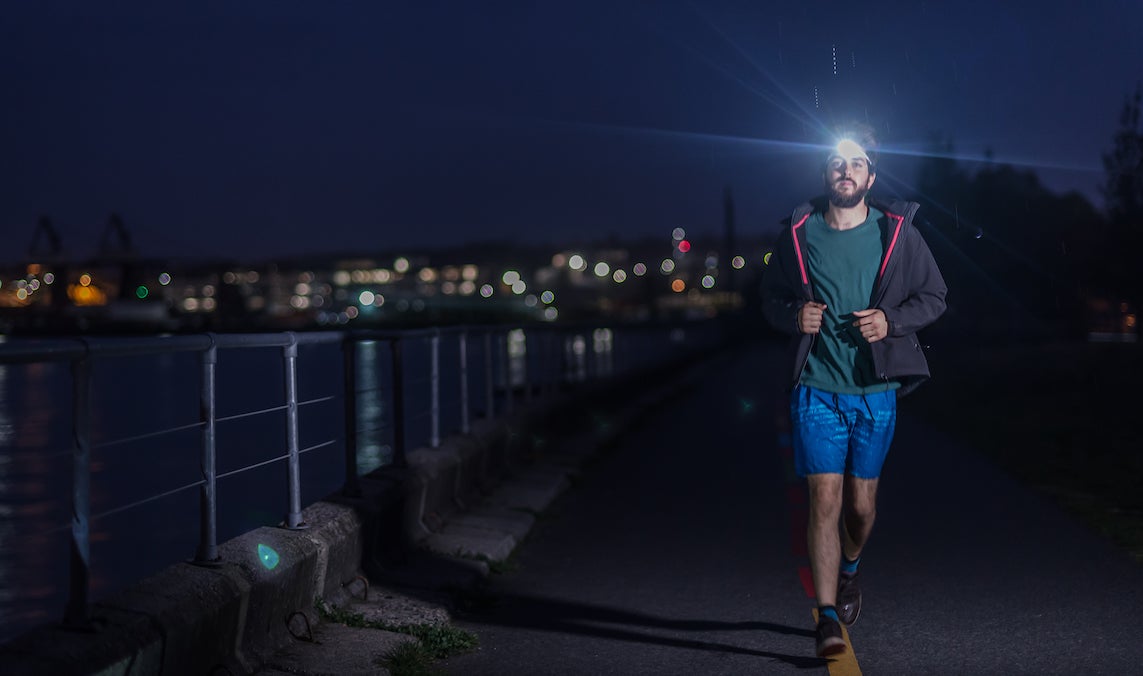
Photo: Getty Images
There’s nothing like feeling fast to make you pick up your pace. That’s one of the beauties of night running: there’s a purity in the sensation of the wind on your skin without seeing the full panorama to contextualize it, the tunnel vision of your light beam as you constantly play catch, like a cat chasing a laser pointer.
The long days of spring and summer are opportune for running in the dark, when cool nights offer runners looking to avoid scorching daytime heat more accommodating temperatures. Summer can lure you out into the middle of the night, but dawn or dusk runs are less likely to upset sleep cycles.
In contrast, winter’s short days force many to have to run in the dark. Darcy Piceu, an ultrarunner who trains in Boulder, Colorado, and who has had to run through the night in many of her ultra trail wins, says she doesn’t really practice night running per se. “I run early in the morning or early eve in the winter when it’s dark out. I don’t train sleep deprivation by running through the night though. Winters provide a nice opportunity for night training because the days are shorter.” Piceu says she doesn’t really worry too much about running alone at night, but sometimes brings her dog if she’s feeling uneasy. “That usually helps.”
Aliza Lapierre, a sponsored ultra-distance runner from Vermont, finds night running exciting because routes she’s run many times during the daylight seem different in the dark. “You see and hear things that you might not normally see and different senses are heightened so it’s almost like a whole new world, especially on trails.”
Mario Mendoza, an ultrarunner out of Bend, Oregon, does some of his training at night out of work and family necessity. “It’s fun once you get used to it,” he says, “especially on nights that are warm and the moon is out. Night running can be very peaceful and beautiful.”
RELATED: The Science of Being Seen at Night
ADVERTISEMENT
Night Running Basics

If you’re thinking of joining these runners and heading out into the dark, here are some helpful pointers for night running:
- Be aware that parts of your vision, even with a good light, will likely be hampered. Depth perception is poor, details like branches often go unnoticed until too late. Shadows can wreak havoc, especially on technical trails. So some wear clear or photochromatic glasses to protect against branch pokes or bug intrusions.
- Slow down. Night running isn’t the best opportunity for tempo efforts unless you are on smooth, secluded roads or a track.
- Be aware of your surroundings and turn off your music. You are already reducing your vision, so allowing your hearing to be as sharp as possible is crucial.
- Practice makes perfect. Don’t make your first night running experience your first ultra.
- Navigation at night is especially difficult, especially on trails. Bring your phone or GPS device if there’s a chance you’ll need it. If the area is really remote, stick to safe roads to get used to navigating in the dark. Pre-run—in daylight—any routes where getting lost at night is at all likely to give yourself a better chance of recognizing every turn.
- Poles can help with proprioception on rocky or otherwise tricky footing.
- Go with a friend, especially if there are wildlife or human dangers, but keep your social distance.
- To ward off any uninvited animals or individuals, carry some sort of siren, like Nathan’s SaferRun Ripcord Siren, which can be heard up to a city block away, or pepper spray.
Choosing a Light

Ultrarunners, who run through the night often, develop specific lighting preferences.
Mendoza’s night runs are primarily on road and he uses a rechargeable Petzl light with 200 lumens and has a few Black Diamond lights as backups for races.
Lapierre classifies her “trail mentality” as “the more lumens the better, as my eyes seem to appreciate a lot of light.” On trails her two preferred headlamps are the Petzl Nao and the Petzl Swift RL. “These lights are a little larger and heavier than the urban torches I wear, but with that comes more lumens. These lamps are also great because they have reactive lighting technology so they automatically brighten or dim depending on where you are looking.”
Lapierre’s lighting choices vary depending on the terrain, how long she’ll be running and the weather. She likes to be prepared. For roads, where the surface is generally predictable, she wears a lightweight headlamp that allows her to see directly in front of her and helps her to be seen by others.
“I have headlamps that are 200 to 400 lumens and are very light and comfortable so I don’t mind wearing them,” she says. “Two of my favorites are the Petzl Bindi which is uber lightweight and amazing for urban running and then the Black Diamond Storm 375 for rural back roads.”
Piceu’s favorite combination is a Black Diamond SPOT headlamp on her head and another headlamp around her waist. And she says she always carries extra batteries due to a lesson learned from a misadventure where she was pacing a friend during a 100 miler and both of their lights went out and neither had back-up batteries.
“This was a BIG rookie mistake—and neither of us were rookies! I ended up using the light on my phone until that went out. Then we had to wait until the next group of runners came up to us and they thankfully loaned us a light. It was so embarrassing.”
