Published December 9, 2025 06:00AM
Get Stronger and Run Better Off the Bike with This Off-Season Training Method
Looking for a new challenge that offers both mental and physical benefits? Fitness racing might be for you.

Hyrox workouts offer a new challenge that trains parts of your physical and mental toughness triathlon doesn't this off-season. (Photo: Hyrox)
Recently, World Triathlon made news when it added another form of fitness racing, Hyrox, to its portfolio, drawing more attention in the triathlon community. This isn’t the first time we’ve heard of the fitness competition in our sport – for the past few years, it’s popped up as a post-retirement sport for some pros (like Ironman and 70.3 world champion Sebastian Kienle) as well as an off-season or cross-training activity for age-groupers.
So what is Hyrox, and why do triathletes love it so much? Let’s take a look at what multisporters need to know.
What is Hyrox?
Hyrox was founded in 2017 by race organizer Christian Toetzke and Moritz Fürste, an Olympic gold medalist in field hockey. Toetzke and Furste wanted to create an inclusive, standardized hybrid fitness race that combined running and functional strength exercises.
The first competition was held in Hamburg, Germany, and has since exploded in popularity, with over 100 races planned globally for the 2025/26 season, sometimes drawing over 5,000 competitors.
The season culminates with Regional and World Championship races. Hyrox competitions consist of a 1K run followed by eight timed “functional workout stations,” for a total of 8K of running.
The functional workout stations are:
- 1,000-meter ski erg
- 50-meter sled push
- 50-meter sled pull
- 80 meters of burpee broad jumps
- 1,000 meters of rowing
- 200-meter farmer’s carry
- 100 meters of walking sandbag lunges
- 100x wall balls
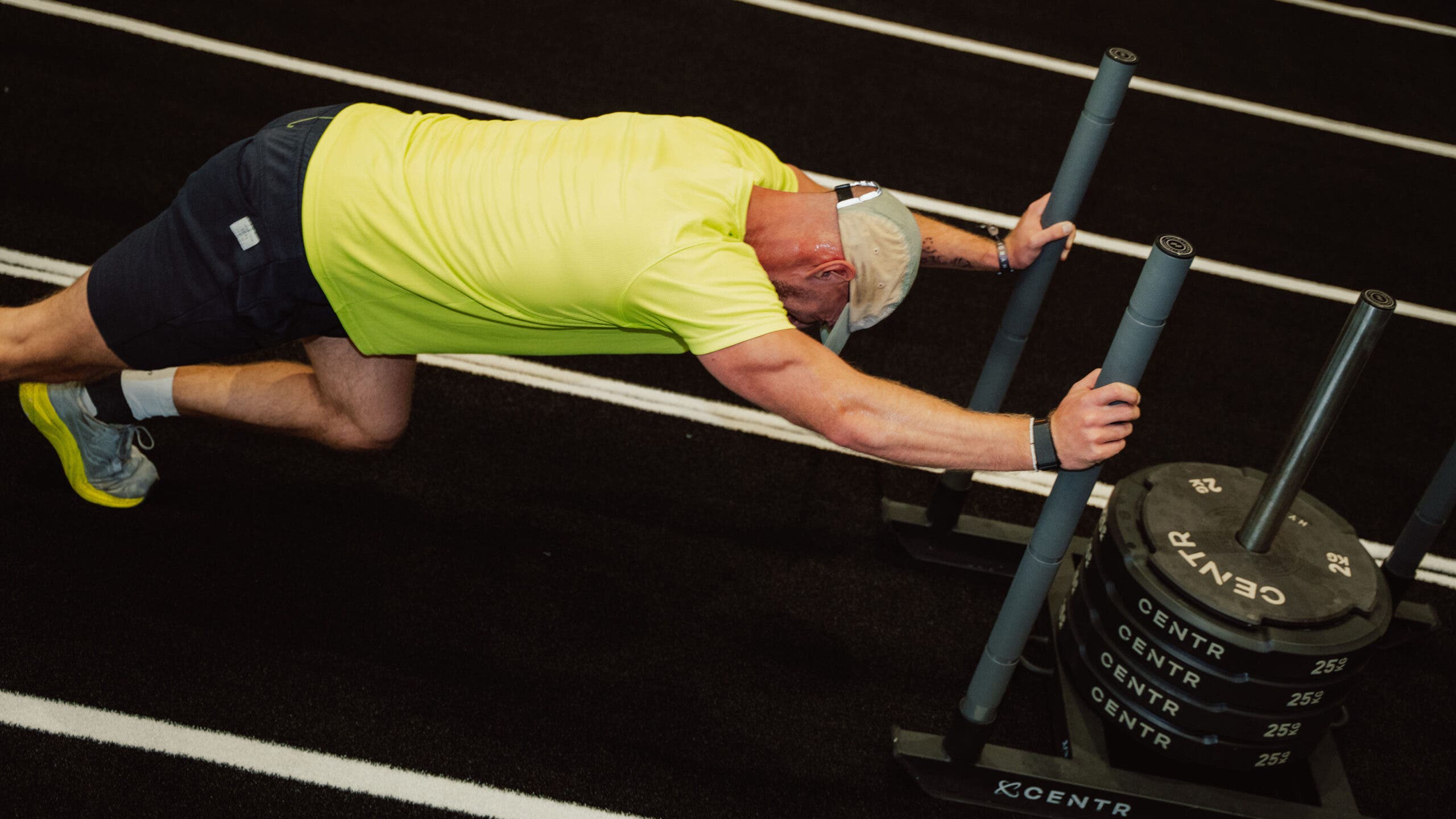
There are four Hyrox divisions – Open, Pro, Doubles, and Relay (all with male, female, or mixed options), and athletes are allowed to self-select their level.
ADVERTISEMENT
Doubles division athletes compete with a partner, running together but splitting workout stations, while relay teams consist of four members who each run 2x1K followed by one workout station.
Exercises are kept standardized for each division, with the Pro division lifting heavier weights than the Open. Weights are also scaled by gender. Pro division athletes (as well as 60+ year olds and mixed doubles) are eligible for a designated number of World Championship slots at any competition, whereas qualification in the Open division only occurs at Regional Championships.
Competitions are meant to be inclusive, with no cutoff times and waves starting every 10 minutes. While top athletes typically complete the race in an hour or less, more typical times are in the 1.5-2 hour range, with some athletes taking closer to 3 hours – meaning triathletes should not feel intimidated to try a race!
What are the benefits of Hyrox for triathletes?
Hyrox’s functional workouts can help develop fitness aspects that aerobic-focused triathletes often neglect, such as full-body strength and power development. The exercises fall into major movement categories – squat, hinge, push, pull, carry – that will increase overall physical capacity, including coordination, grip strength, and balance.
ADVERTISEMENT
Hyrox requires significant core strength and multi-directional stability, which helps build more solid triathletes. The overall duration of the event, interspersed with high-intensity work, challenges athletes both aerobically and anaerobically, covering all aspects of fitness.
What are the risks of Hyrox for triathletes?
Like with any new exercise program, injuries can happen when starting new, high-intensity work. Moving straight from a season of slow-twitch dominant triathlon training into more ballistic, power-based movements challenges muscles, tendons, and joints with higher loads. Triathletes should work their way up to the training load required for Hyrox.
Many athletes also pick up Hyrox in the off-season, but be sure to allow adequate recovery time from your race season first.
Because Hyrox is performed at a high relative intensity for over an hour, underfueling also becomes a risk, as the body will torch through carbs while training and racing without an easy chance to refuel. So, be sure to keep that simple carb intake up before sessions and replenish afterward.
ADVERTISEMENT
Why are triathletes turning to Hyrox?
Over the past several years, numerous age-group, current, and former professional triathletes have dabbled in Hyrox, particularly during the off-season. After full seasons of obsessing over swim/bike/run, Hyrox offers both a new physical challenge and a mental break, with new, varied training.
The endurance base and aerobic capacities triathlon training builds set triathletes up with a solid foundation from which to build strength, which is often a needed off-season focus for endurance athletes.
ADVERTISEMENT
This is echoed by long-time triathlete, runner, and sports dietician Stevie Lyn Smith, who states, “As I’ve aged in sport over the last 15 years, I noticed the big missing component for me was a solid strength training routine in addition to my usual multisport training. As I got stronger and more confident in the gym, I was looking for ways to move differently, especially when not in a big race training block. The movements in Hyrox were new to me and a great anaerobic challenge for a triathlete who loves to work aerobic fitness.”
So, the chance to not just work on other aspects of fitness that build upon triathlon, but also to compete at them (what competitive, type A triathlete doesn’t love that?) has drawn many to Hyrox for a different, valuable challenge.
How can triathletes train for Hyrox without a dedicated gym?
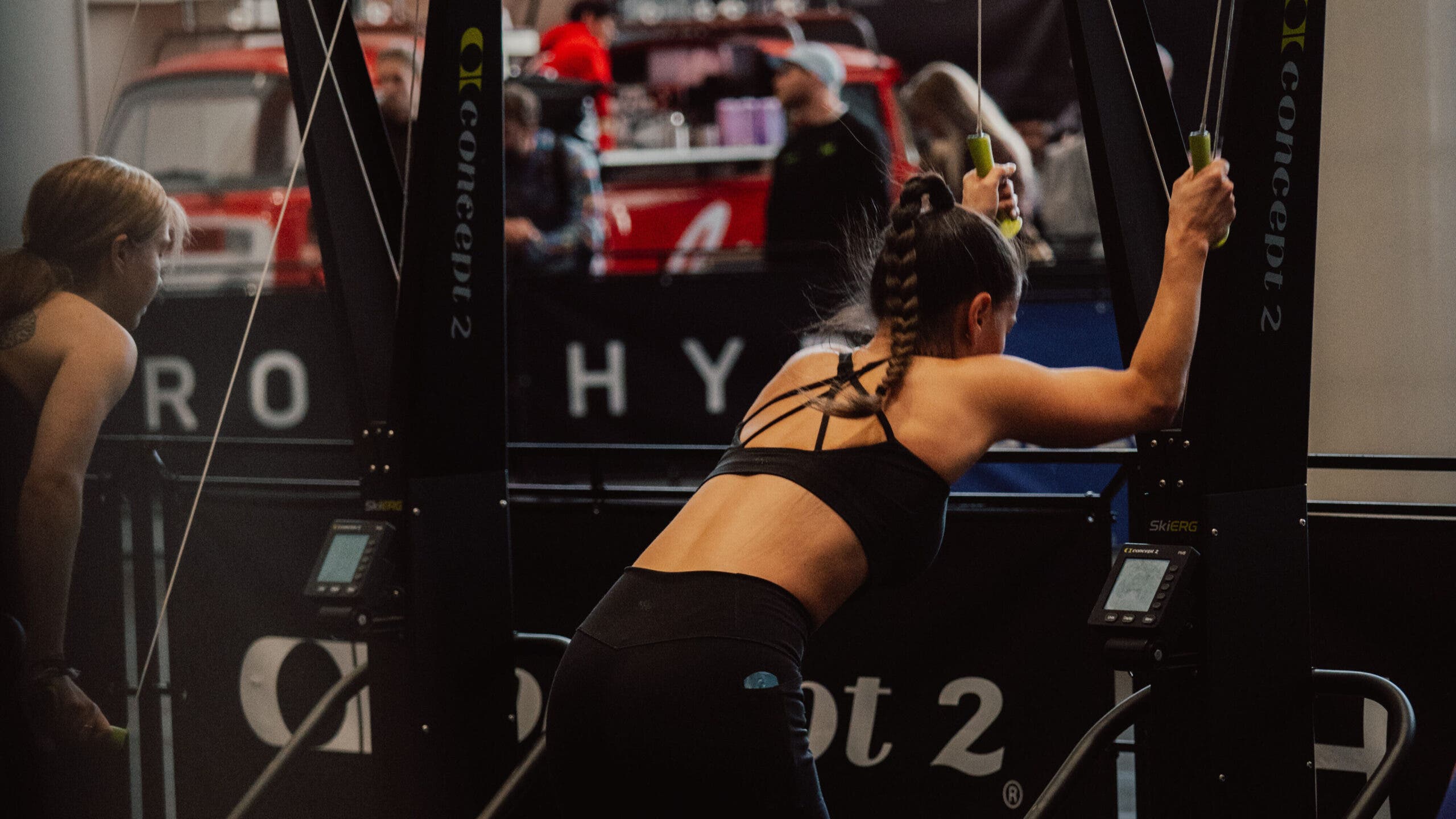
While more and more gyms and fitness facilities are offering options, many athletes may not have easy access to these and will need to find workable home setups.
Some exercises can be replicated relatively simply. No equipment (other than space) is needed to practice burpee broad jumps, weighted lunges can be replicated by loading up a race backpack with weights, and the farmer’s carry just requires an investment in a set of kettlebells matched to race category requirements.
ADVERTISEMENT
Other exercises might need more creativity. While throwing a weighted ball next to a second-story window might not be the best idea, one could simply perform the squat-to-press movement, lightly throwing and catching a heavier ball or overhead pressing with a dumbbell.
How about the sled push and pull? A strong rope or TRX, a tire, some weights, and a quiet stretch of road can be used to create a tire “sled” to pull. For the sled push, a weighted box or a piece of furniture (along with some forgiving family members) can be used, or press into the front bar of a turned-off treadmill and push the belt with your feet.
The specific machines needed for rowing and the ski erg make those the most difficult to replicate at home. Still, while it may not exactly capture exercise demands, simple exercise bands can be used to train “close enough” for these events.
Performing a row while moving from a squat position to standing captures the upper/lower body work of rowing.
ADVERTISEMENT
The ski erg motion can be mimicked by anchoring a band above a doorway or on a high hook and driving both ends down while flexing the hips and trunk back into a hinge position.
With all at-home Hyrox work, however you arrange it, be sure to practice high-intensity running between the workout stations. Just like practicing transitions and bricks for a triathlon, the clock doesn’t stop between events, walking lunges and wall balls feel different when breathless from a 1k run, and those run legs will feel like Jello after pushing a heavy sled and driving up the heart rate.
So, if you’re looking for a new challenge that offers both mental and physical benefits, consider Hyrox. Hyrox welcomes new athletes with open arms and the overlap with the triathlon world continues to expand, making it an increasingly attractive supplement to a year of triathlon focus!
