Updated December 20, 2024 10:40AM
Originally posted onOutside Online
Essential Tests and Exercises for Better Hip Mobility (and Happier Hamstrings)
Stiff and unstable hips put strain on your hamstrings. Here’s how to assess and improve hip mobility, posture and rotational strength.
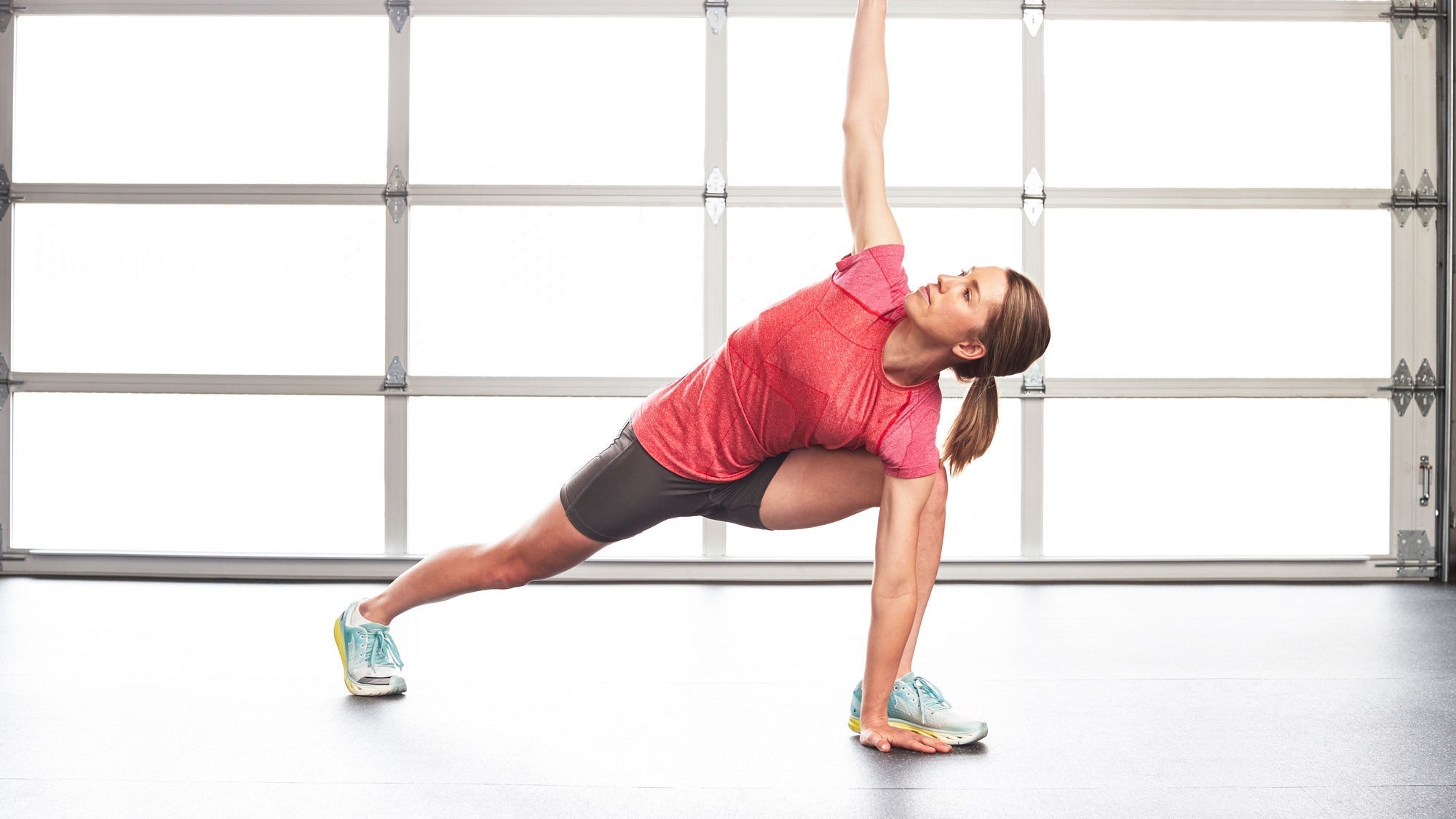
A triathlete practices the twisted warrior while improving her hip and hamstring mobility. (Photo: courtesy VeloPress)
Too much strain can hurt the hamstrings. But strain isn’t just related to the force the muscles have to generate. Poor hip mobility or stability could be the cause.
What is hamstring strain and what causes it?
Strain is defined as length under load. You’re not going to change your load a whole lot when running – you have certain body weight and you want to run faster. Therefore, you want to try to keep the length of tissue in a narrow window. When tissues get in too long of a position, the strain increases and they break down.
Three things cause hamstrings to get over-lengthened and over-strained.
- Your hamstrings are too short for what you need to do. A few people do need to lengthen their hamstrings. However, you don’t need to be a super yogi to be a runner. Lying on your back, if you lift your leg upright, you don’t need to hit 90 degrees – not even close. 65 to 70 degrees is what you’re aiming for because your leg is always going to be bent when you’re distance running. You have to stretch them if you can’t get to about 65 degrees. Most people over-emphasize stretching, however. You need enough range of motion, not too much.
- You lack hip mobility. Most people aren’t deficient in hamstring mobility – but they are in hip mobility. Having tight hip flexors is worse than having tight hamstrings. When hip flexors are tight, it creates pelvic tilt (rotating down in front, up in back). When pelvic tilt increases, your hamstrings are in a longer position in every point in the gait cycle. You notice this especially on the contralateral side. If you have problems in your right hamstring, you likely have left hip flexor tightness, because when your right hamstring is lengthened out in front of you, your left hip is going behind you and it is that tightness that yanks the pelvis.
- You have poor rotational stability. Rotational control comes from hip muscles and foot muscles, not from hamstring muscles. Hamstrings bend your knee and extend your hip. When you’ve got poor rotational control, that puts things under more torque and can strain the hamstring. The hamstring is getting overloaded and it can’t help. Having a stronger hamstring in that situation doesn’t help. You have to fix your rotational balance.
Hip mobility test for triathletes
To find out if you need to work on hip mobility – and the large majority of triathletes do – take this test:
Kneel inside a doorway with your mid-back touching the doorframe. The thigh you are kneeling on should be vertical, and the shin of your opposite leg should also be vertical. In this position, you’ll have a small gap between your low back and the doorframe.
ADVERTISEMENT
Now, tuck your tailbone under so that the hollow between your low back and the doorframe disappears. To make this happen, imagine your pelvis as a bowl of cereal that you are trying to spill behind you. This movement is commonly referred to as pelvic tilt. Once you are in this position, what do you feel?
Stretches for hip mobility
If you feel a huge pull in front of the thigh: Incorporate this kneeling hip flexor stretch into your weekly maintenance work.
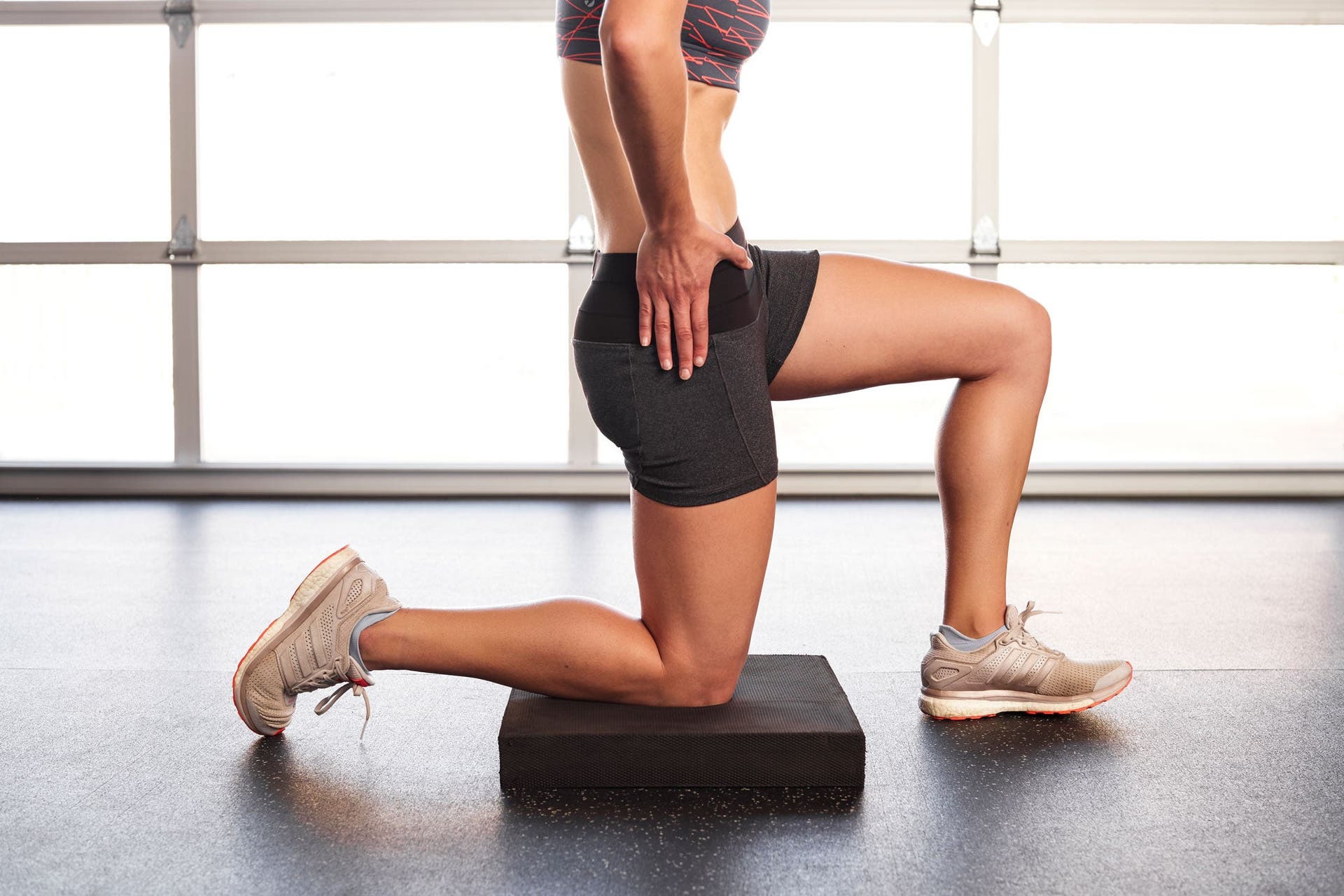
Kneeling Hip Flexor Stretch
- Kneel on a pad or pillow, making sure to keep the thigh of the leg you are kneeling on vertical.
- Tuck your pelvis under as described in the text above. Hold this position for 3 minutes.
- To increase the stretch, position the foot of your kneeling leg out to the side a few inches (this will rotate your thigh inward) before moving into a posterior pelvic tilt.

If, however, in the test/stretch position, you feel nothing or just a gentle lengthening: There is no need to do any static stretches in the hip flexors. However, you should do dynamic mobility movements like the Twisted Warrior to ensure you use the hip motion you do have.
This exercise is not going to elongate tissue but helps use the hip range of motion you do have and to get your body into twisting, not arching. If you have tight hip flexors, you have to elongate. But before you run – whether you have tight hips or not – do the Twisted Warrior to open the hip up, use the hip flexor length you do have, and translate your mobility gains into your form.
ADVERTISEMENT
Twisted Warrior
From standing, drop into a high lunge. Position both hands on the floor inside your forward foot. Make sure the back leg is extended straight behind you.
Raise your outside hand off the floor and twist your upper body, reaching your arm up toward the ceiling. Twist your trunk, not just your arms and head. Hold for a count of one.
ADVERTISEMENT
Untwist your body, and place your hand back on the floor. Repeat with the opposite arm.
Twist 10 times in total (five times on each side), then lunge on the other leg and repeat.
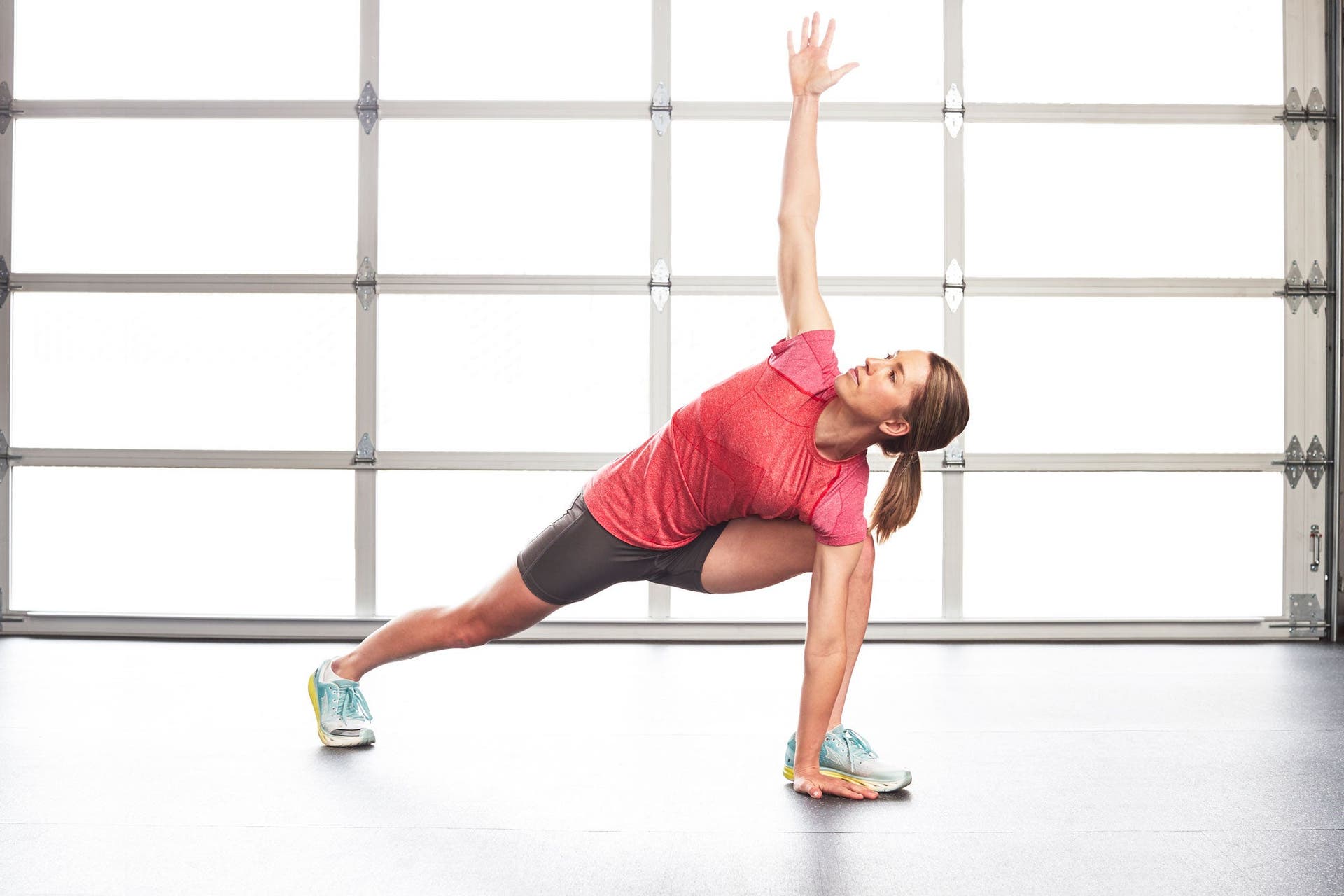
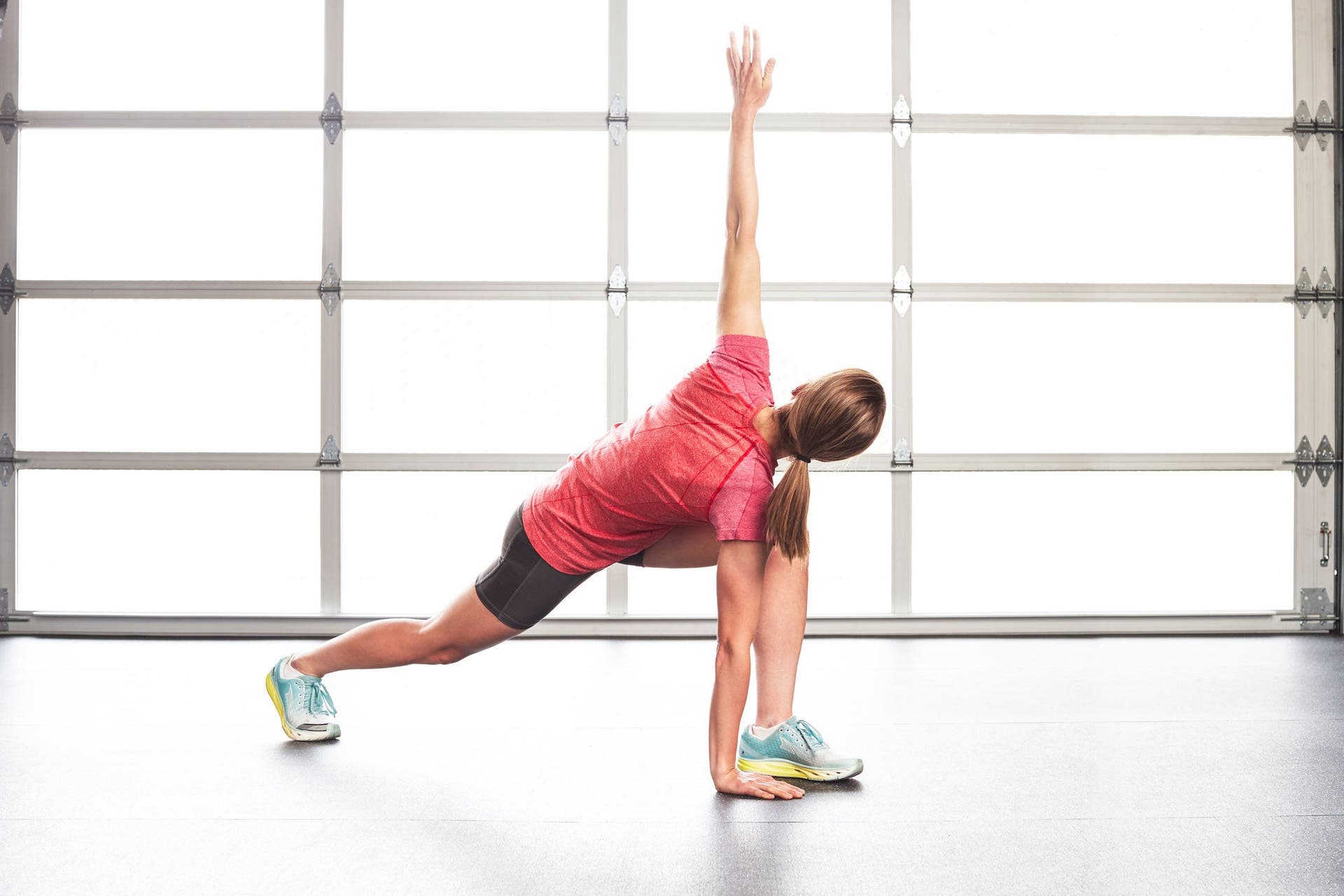
TIP: Imagine you have a camera on your chest, and the goal is to twist the camera all the way to the left and the right to take a picture of the people on either side of you. If you just force your arms into a twist, you won’t get the photo.
Posture test for triathletes
Sometimes runners have good hamstring mobility and adequate hip flexor range but they have really poor pelvic postural awareness – and that creates the same problem. Anything that lets your pelvis go into an anterior pelvic tilt is going to put more load on your hamstring all the time.
This test is easy: Stand up with your feet roughly shoulder-width apart and relax into your normal posture. Go on and give it a try. Where is your weight?
- If your weight is at midfoot: Great! This is the best position for doing anything active. This is your neutral spine position.
- If your weight is at rearfoot: Place one hand on your belly button, and one hand on your breastbone. Keeping the lower hand and the belly still, slightly drop the ribs down and forward until you feel the balance point shift away from your heels and to your midfoot. Make sure you are moving from the rib cage – not from the neck! Now maintain this trunk position and let your arms hang down by your sides. Rotate your hands so your palms point forward, which will help screw your shoulder blades down and along your back. Now, keep the shoulder blades back and relax your arms.
- If your weight is at forefoot: You are likely leaning too far forward from the ankles, or leaning forward from the low back. Pull your hips back slightly with respect to your feet and see how you feel. If this brings your weight over your midfoot, great. If you are now on your heels, run through the rearfoot sequence above.
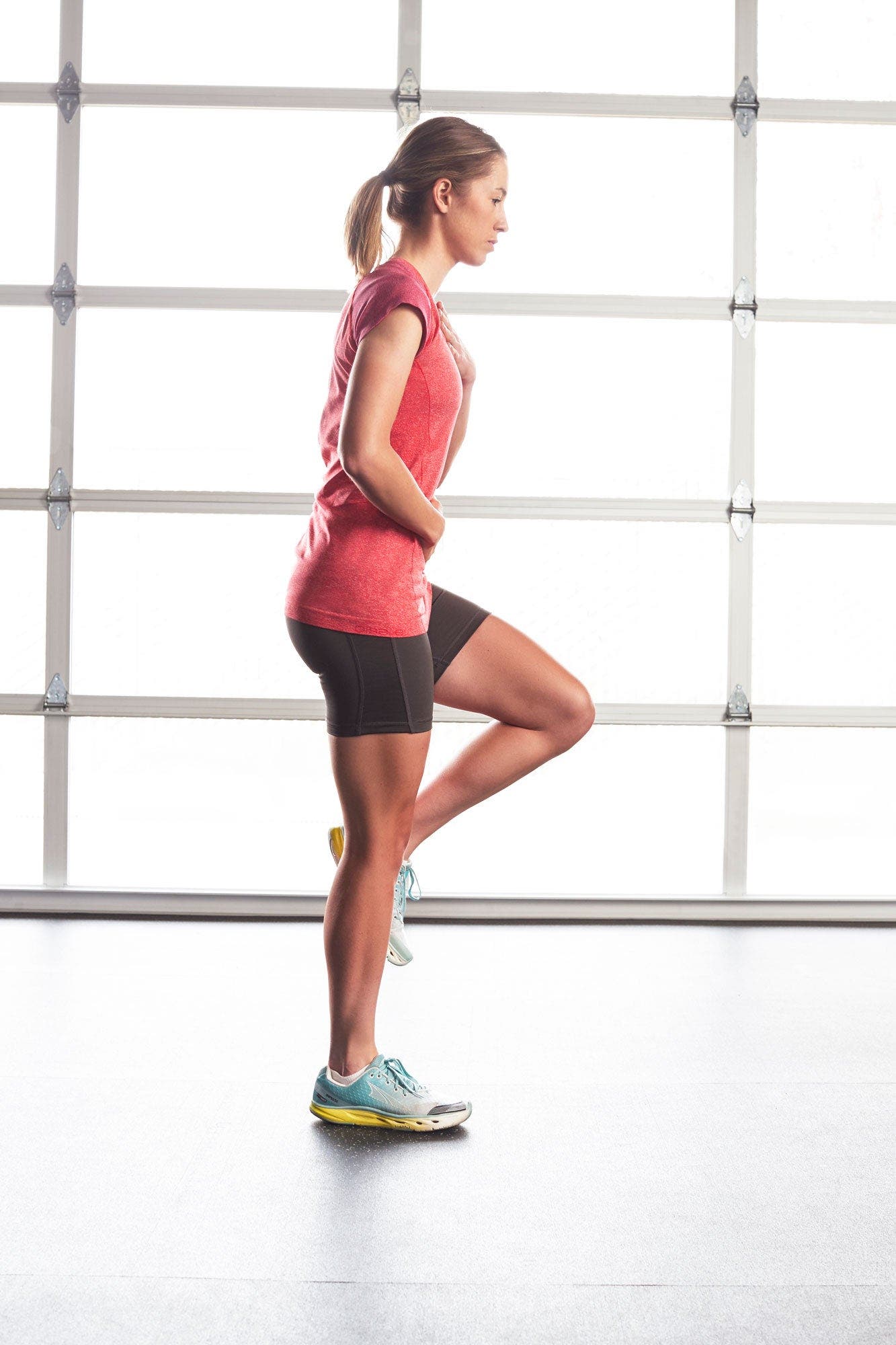
Once you find your neutral spine position, stand on one leg and then the other. Make a mental imprint of how this position feels and come back to it every day, on every run, until it’s wired into your muscle memory.
ADVERTISEMENT
Rotational stability exercises
All runners can benefit from improving rotational control. By targeting rotation, you can ensure that your core is working in tandem with the rest of your body, not in isolation.
You can do numerous exercises to improve your rotational balance. Start with the Twisted Warrior, above. Advance to the Banded Hip Twist and Rotisserie Chicken, below.
Banded Hip Twist
Anchor a TheraBand at waist height, stand square to the band, and pull the band around your pelvis so that it sits just below your waist.
ADVERTISEMENT
Put your hands on your hips, holding the band in place with some tension on it.
Stand on the leg where the band ends (if the band wraps around from the right, stand on your left leg) and rotate your pelvis in and out while keeping your hips level.
Do 40 reps on each side.
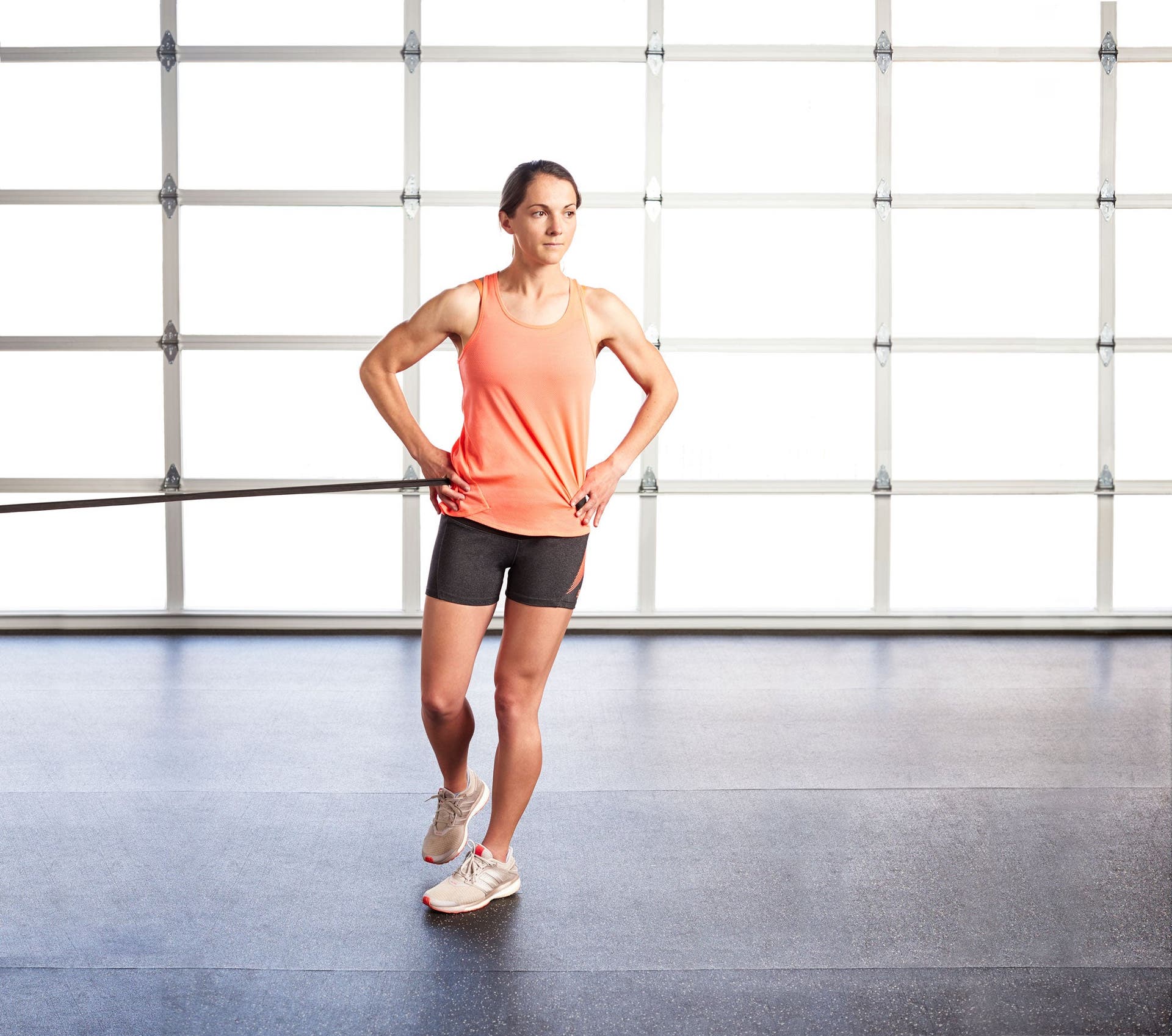
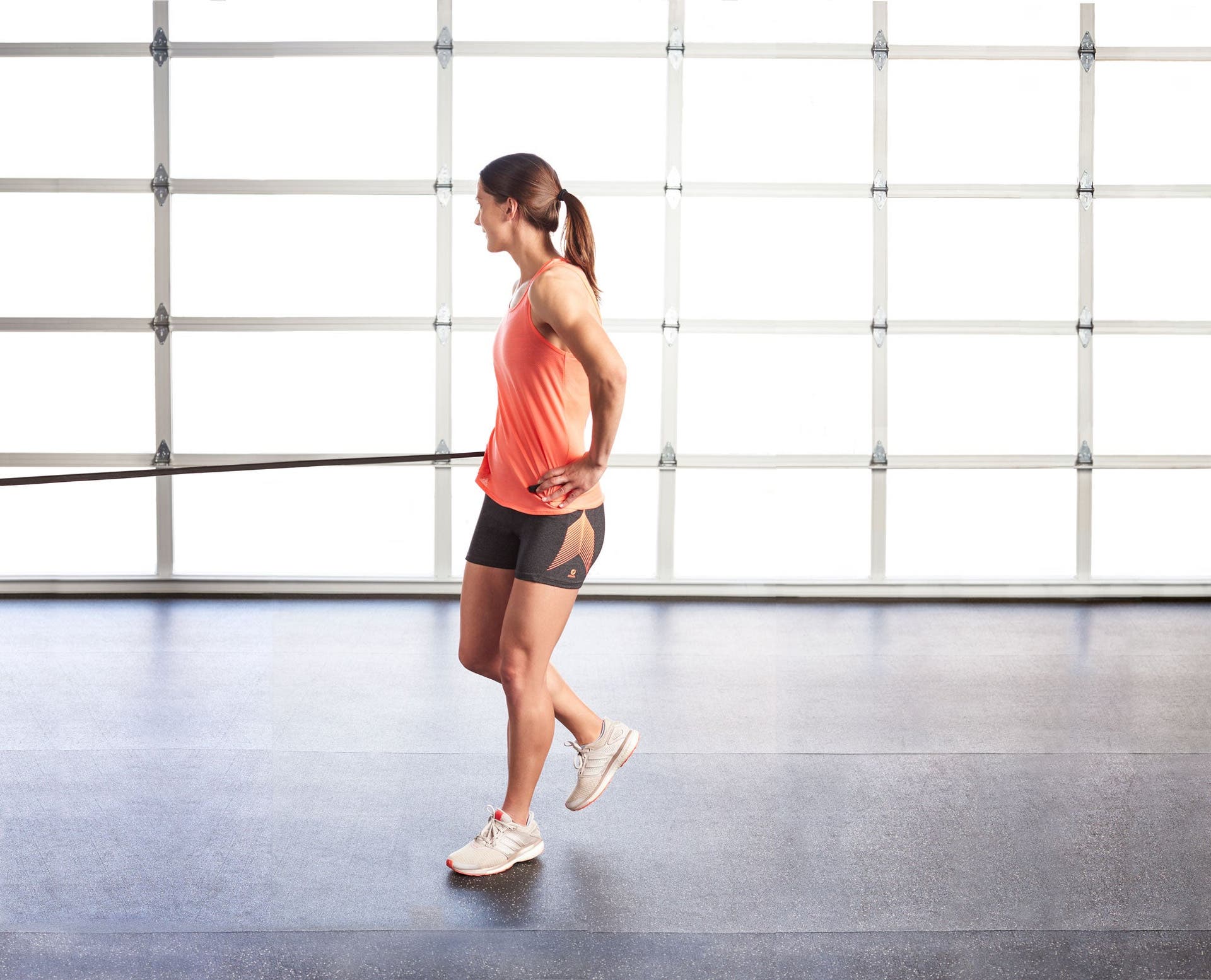
TIP: Step closer to the attachment to ease the load and farther away to increase the load.
ADVERTISEMENT
Rotisserie Chicken
Lie on your back and place one leg in the suspension trainer, with the strap just below your knee. Extend your free leg next to the sling leg. Lift your hips into a bridge and extend your arms above your chest, palms together.
On the sling side, keep your kneecap pointed up to the ceiling and rotate your pelvis away on an imaginary axis, as if you were on a BBQ spit.
ADVERTISEMENT
Rotate back inward past the start position. The hips should twist fully inward and fully outward each rep – your back stays quiet and your hands remain extended above you.
Do 2 sets of 8 reps on each side.
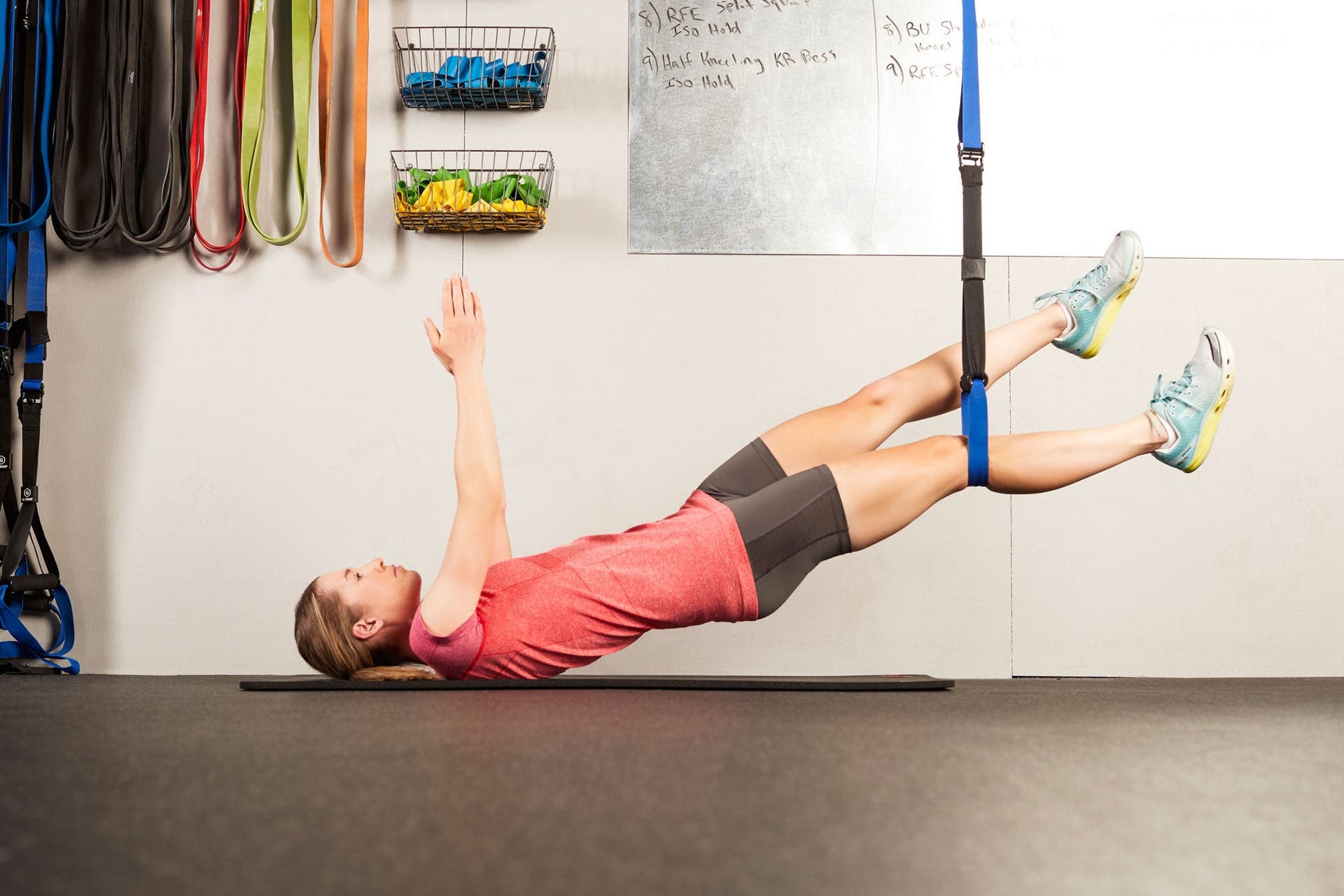
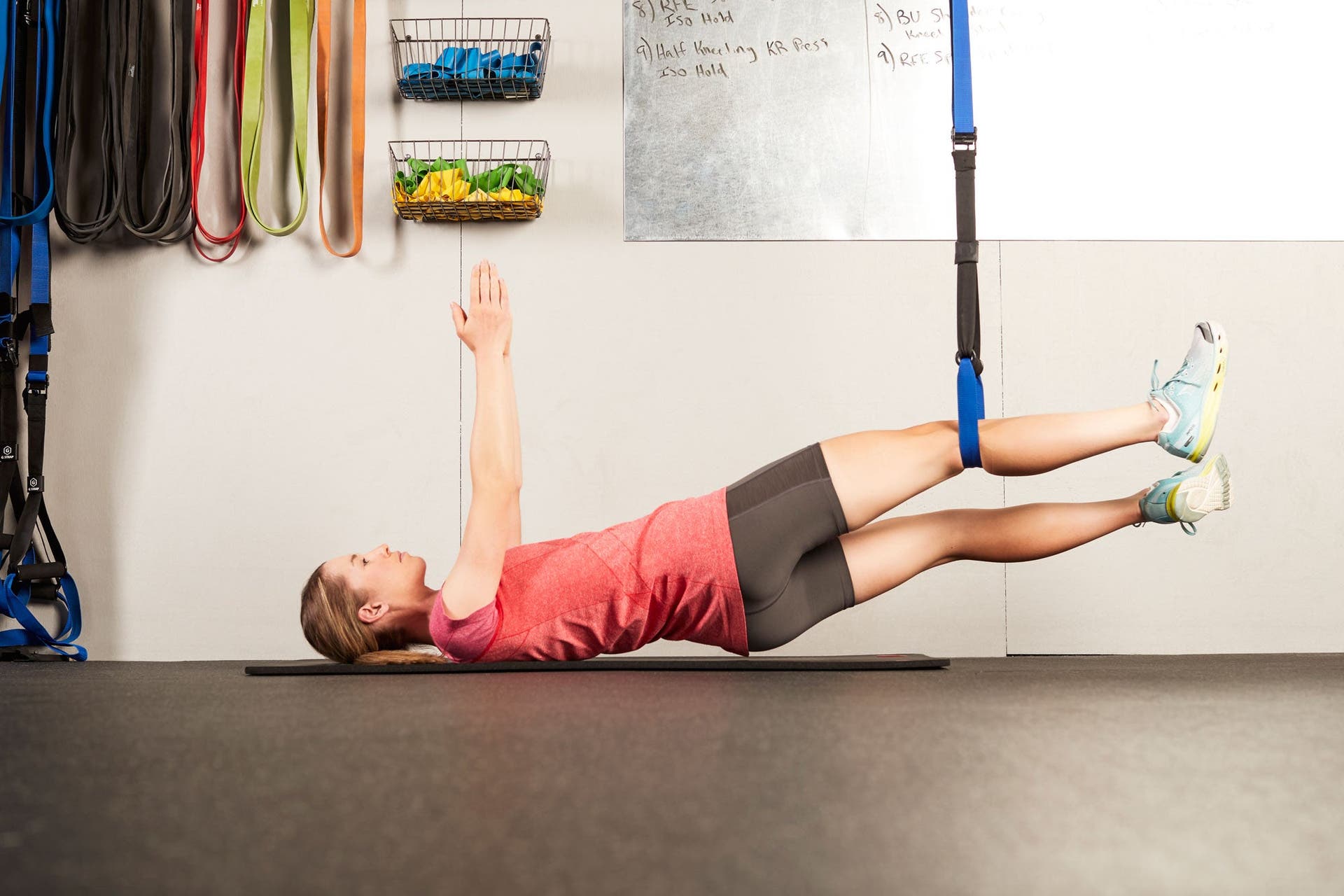
Tips: Pay attention to whether you are twisting equally to the right and left sides. If you feel any tightness in your low back, drop your chest slightly until it dissipates.
Sore hamstrings? Here’s what to do
Just because your hamstring is sore doesn’t mean you have to stop running. Sometimes you have to, but a lot of times you can keep going. If you’re dealing with a sub-acute strain, and you can run but it is a little bit painful, you don’t have to take total rest.
Just run a bit slower with a shorter stride, focus on contacting closer to you. Or run uphill, which also creates a shorter stride. The strain isn’t from effort but from the longer position, so most people with low-level hamstring strain can go uphill pretty well. Be careful to come downhill slowly, with short steps.
ADVERTISEMENT
Motion is good for the tendon – you want to use it and load it. To strengthen, you can start with isometric exercises like holding a 10-degree incline in a Nordic Curl, or do an isometric hamstring curl: while lying prone, lift an ankle weight to 45 degrees and hold. Advance to a moving load on both the hip component and knee component of the hamstring’s connections.
But even more important is to make sure your pelvis isn’t in an anterior tilt. Everything that elongates up top is even more of a factor than from the bottom. If you’ve got a big anterior tilt, you’re taking the hamstring into a vulnerable range even running slowly with short strides.
Check out Outside Learn’s complete course with Jay Dicharry on maximizing your stride’s stability, strength, and durability for more efficient, less stressful miles: