Published December 5, 2025 06:00AM
If you buy through our links, we may earn an affiliate commission. This supports our mission to get more people active and outside.Learn about Outside Online's affiliate link policy
These $130 Compression Boots from Costco Are Fire
High-end compression boots can run upwards of $1,000 - but are they really worth it? And what happens when a $130 challenger shows up?
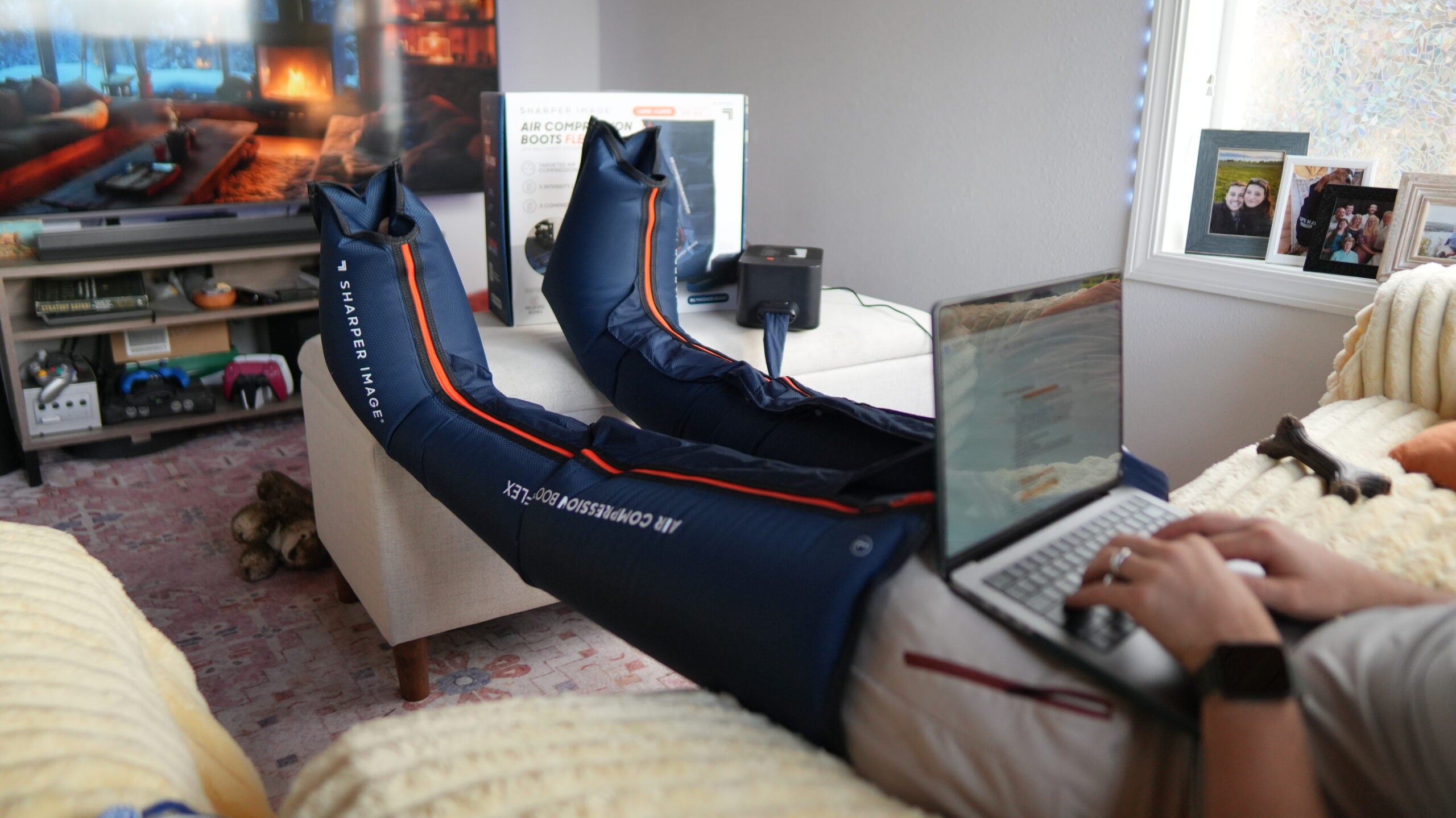
Costco is selling compression boots for $130, and they caught the attention of social media editor Travis Mundell. (Photo: Travis Mundell/Triathlete)
Costco compression boots review
How did I go from forever daydreaming about owning a full-sized compression boot system, but never willing to make the hefty investment, to my wife (who famously resists my further triathlon spending) impulsively buying me a set? Let me explain.
A couple of weeks ago, we headed over to a typical dinner/game night with our two closest friends, who are also triathletes. We walked into Ethan and Joey’s home to find a dark-blue-and-orange zippered pair of compression boots sprawled across the couch. Knowing the games were likely to happen from this couch, clearly, Ethan had left them out to garner some attention.
Dinner was still being prepped, so without hesitation, I bit and immediately began questioning him on the purchase: Why buy these now, after our recent Ironman in Chattanooga?
That’s when he told me the saga – how a friend of his bought a pair of these boots at Costco months ago and was insisting he get some too, making some bold claims along the way. Yet despite his rush to snag a pair, they had already sold out.
ADVERTISEMENT
Ever since, he’d been frustrated and desperately curious to try them out, leaving him constantly checking in-store and online, always ending up empty-handed… until the day recently when they finally reappeared. He grabbed them on sight, no hesitation.
As the chambers inflated around my legs, he continued to rave about them, but my scepticism remained. “Sharper Image,” I thought, “no way these could be any good.” Then, moments later, I was busy doing my best impression of Owen Wilson, muttering “wow” on loop as the pressure kicked in – far stronger than I ever expected from a setup coming from a store that also sells frozen pizzas (and oxtails, and…). I sank deeper into the couch, secretly hoping the group would forget I existed and game night would start without me.
But the final “wow” came next: He said he got them for just $130 on sale.
ADVERTISEMENT
That was all my wife needed to hear on the other side of the couch. My Christmas present had just been resolved; she purchased them immediately online and saved herself from listening to my insufferable internal debate on whether to purchase them myself. What she didn’t realize was that our other friend’s wife was, at that exact moment, ordering a pair for her husband too.
So, within 10 minutes, two more sets had basically sold themselves – proof enough that these things are the real deal… and why they might already be out of stock at your local Costco.
Let’s dive in.
What are compression boots, and how do they work?
First, a quick primer on compression boots if you’re new to them. At their core, they’re relatively straightforward devices: air-filled sleeves that inflate and deflate in programmed cycles. Some use a single chamber that tightens all at once, while others have multiple sections that compress in sequence. This rhythmic pressure is designed to encourage blood flow, activate the lymphatic system, and generally support healthier circulation and faster recovery.
Their effectiveness is still being studied and is largely empirical, but a growing number of research papers – like this one – suggest “there is a positive response from the IPC [intermittent pneumatic compression] when compared to passive recovery.”
Costco compression boots basics
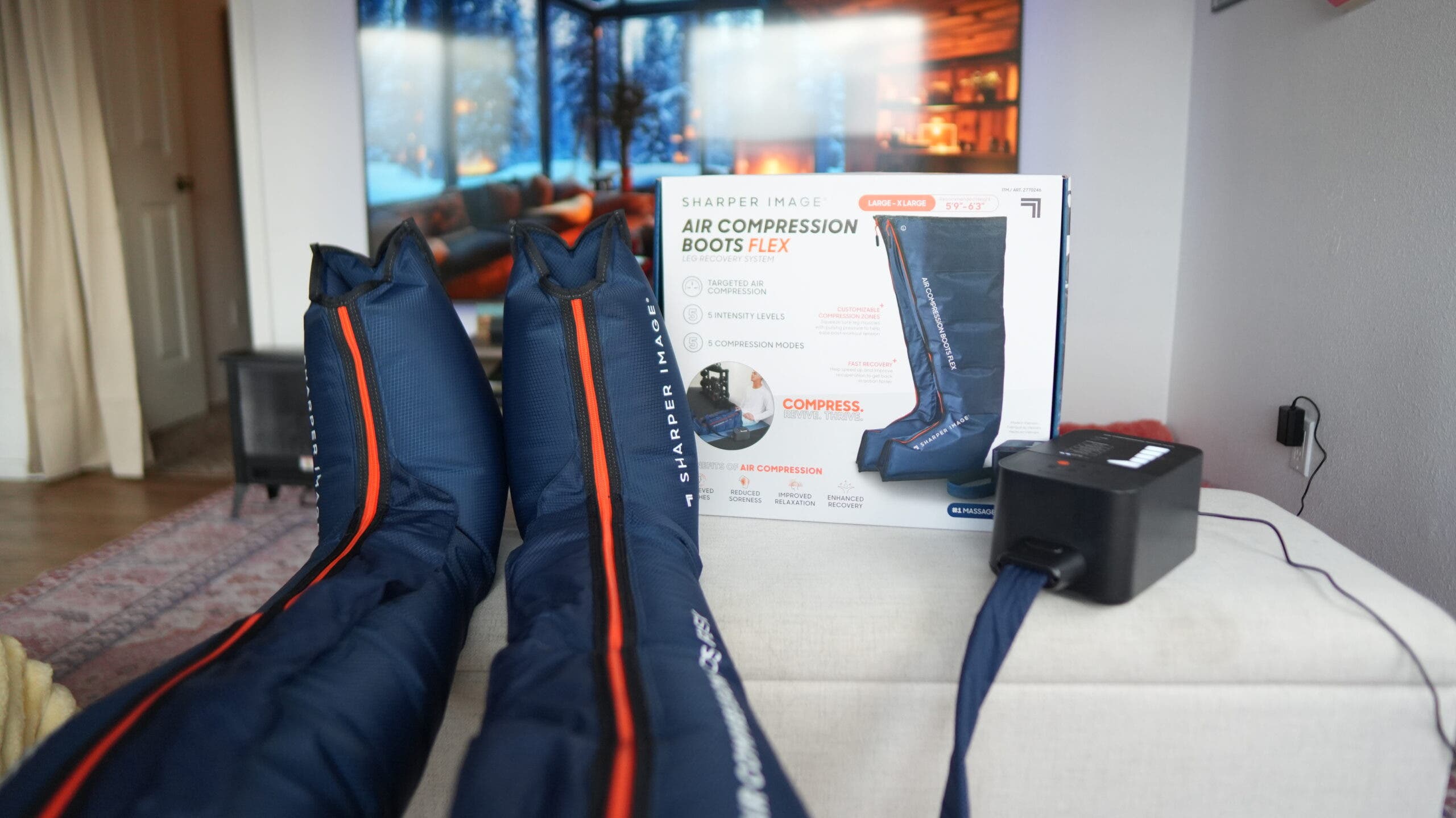
The Sharper Image Air Compression Boots are a full-leg compression boot setup that can treat one or both legs at a time. The compact, foldable sleeves inflate through multiple air chambers, delivering anything from steady, gradual pulses to a sequenced, progressive massage from top to bottom – or even targeted pressure to specific zones – depending on the setting and intensity you choose.
Pros
- Simple and user-friendly: Sets up in minutes and is intuitive to use the control unit.
- Strong compression: Five levels of compression paired with five different modes for precise control.
- Easy to wear/store: Leg sleeves are light, collapsible, comfortable, and easy to put away. Materials and zippers feel durable.
- Easy to clean: The non-breathable material can get sweaty, but it wipes down quickly with an alcohol wipe.
- Price: Typically on sale for as low as $129.99.
Cons
- Bulky control hub: Heavy and not easily portable.
- Loud: Louder than a high-end compression device, although not intolerable.
- Deflation time: If you want to stop midway through, it can take a minute to deflate and fold away. (Doesn’t self-deflate – air must escape).
- Consistently sold out: The worst thing about this product is how hard it can be to find.
Specs
Weight: Boots + control hub: 8.5 lbs
Price: $129.99
Power: Corded (not wireless)
Brand: Sharper Image
Sizes: S-M: Height: 5’0-5’8″; L-XL: Height: 5’9-6’3
The Sharper Image Air Compression Boots Flex Leg Recovery System Review
The good
Despite how much I enjoyed that short trial run at my friend’s house, a part of me still felt skeptical. Surely these boots were too good to be true. And by the time my own pair arrived, I’d nearly talked myself back into doubt – already plotting to uncover the reason behind the exceptionally low price tag.
But the first impression shut that down fast. The packaging was neat, organized, and surprisingly refined – nothing about it screamed AliExpress or TEMU TOP RATED special lightning deal bargain.
When I pulled everything out, I was impressed by how compactly the boots were packed and how sturdy the material felt. The leg sleeves, at least, seemed built to last. The control unit, while large and heavy, felt reasonably durable, though the plastic on the hose connections struck me as slightly less premium and something that might be more vulnerable over time.
ADVERTISEMENT
The setup was plug-and-play, and within minutes I was zipped in for another blissful 30-minute session, flipping through modes and appreciating how even the pressure felt. No pinching, no hotspots – just smooth, strong compression.
The very next evening, I found myself back in them for over an hour, cycling through modes as we unwound for the night. I couldn’t believe these boots came this close to the high-end systems I’ve tried at multiple triathlon expos, especially at this price.
And as for the effect on my perpetual stiffness and soreness? Well, even though the science behind the effectiveness of IPC devices continues to evolve, it is impossible to deny that they always make me feel incredible in the moment, and they certainly leave me feeling fresher, looser, and more optimistic for the next workout. Plus, for triathletes like myself, who often need a compelling reason to sit down and relax, that alone feels worth it.
The OK
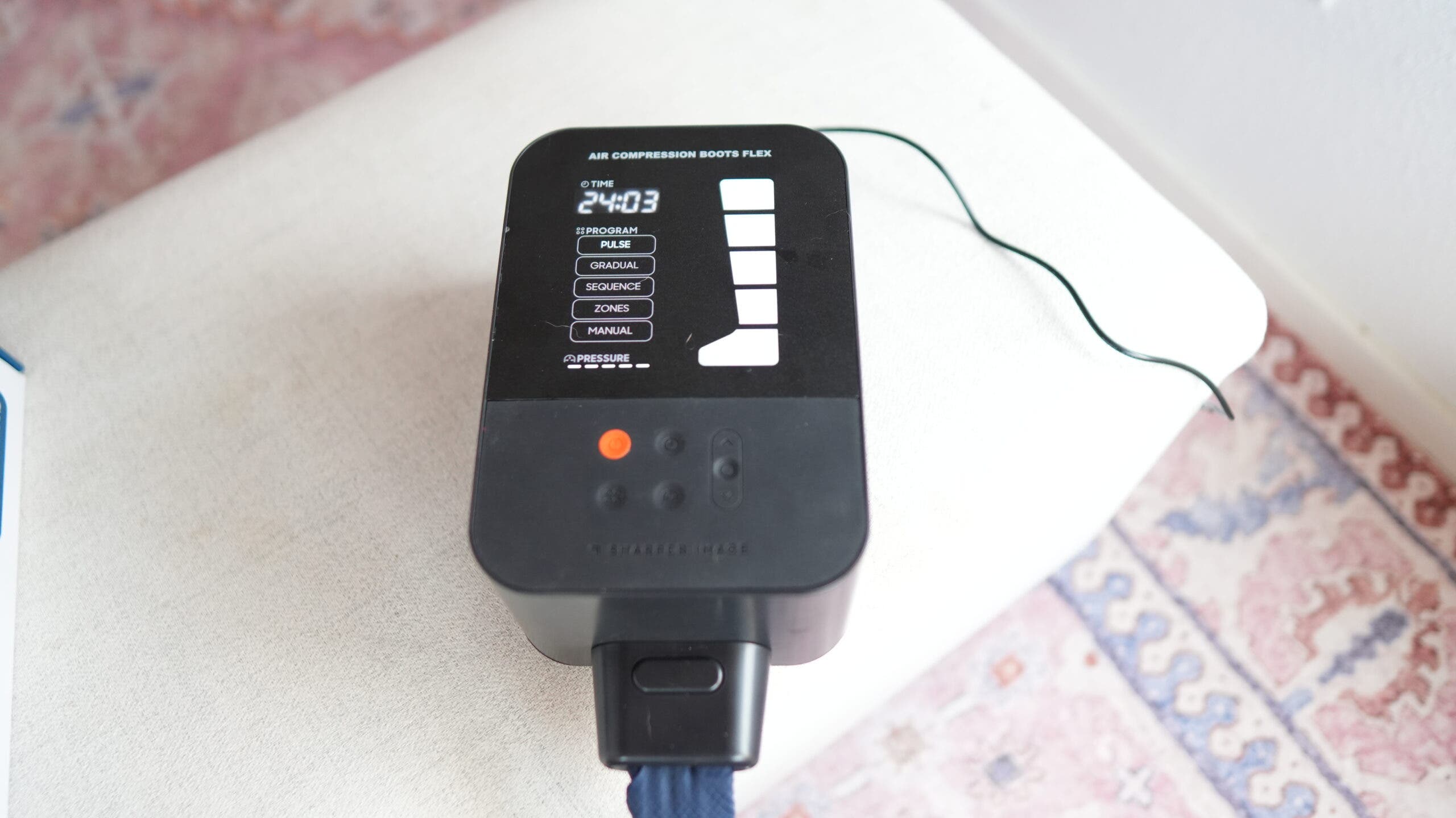
There are, unsurprisingly, a few drawbacks, though none that feel like deal-breakers. The most noticeable is that the boots don’t automatically deflate when a session ends. They will allow air to escape, sure, but it’s slow, and the device doesn’t actively push the air out. If you need to stop mid-cycle, getting out can feel a little clumsy, and getting back in right away isn’t much smoother. It’s not a huge issue, but it’s something that one might find irritating in the long term.
ADVERTISEMENT
Portability isn’t their strong suit either. The control box is bulkier than you’d expect in this day and age, and even though the sleeves fold down fairly easily once the air is gone, you certainly won’t be taking this to your next destination race. However, compared to the several hundred dollar price jump for a more streamlined wireless option like the $900 Normatec 3s, that might just be OK.
Finally, the control unit is also somewhat loud, emitting a steady huff-and-puff. Enough that you’ll feel guilty hearing it if you’re watching a movie with your spouse nearby – though when I asked my wife to rate the annoyance level, she gave it a 3 out of 10 – a surprisingly generous score from someone who never sugarcoats anything.
Conclusions
Christmas came early with these boots. As I said in the intro, I never imagined I’d end up owning a pair – much less one I’d genuinely recommend, but especially at this price, it’s not difficult. It’s rare to find gear that feels like an easy yes from every angle. But considering the value and how often you’ll actually use them, the cost per hour might be one of the best returns on investment in triathlon gear right now.
