Updated November 24, 2025 05:08AM
Recalled: Ultraman’s (Very) Long and Storied History
One race is more “more” than the rest: Ultraman has existed in the farthest realm of multisport for more than 40 years.
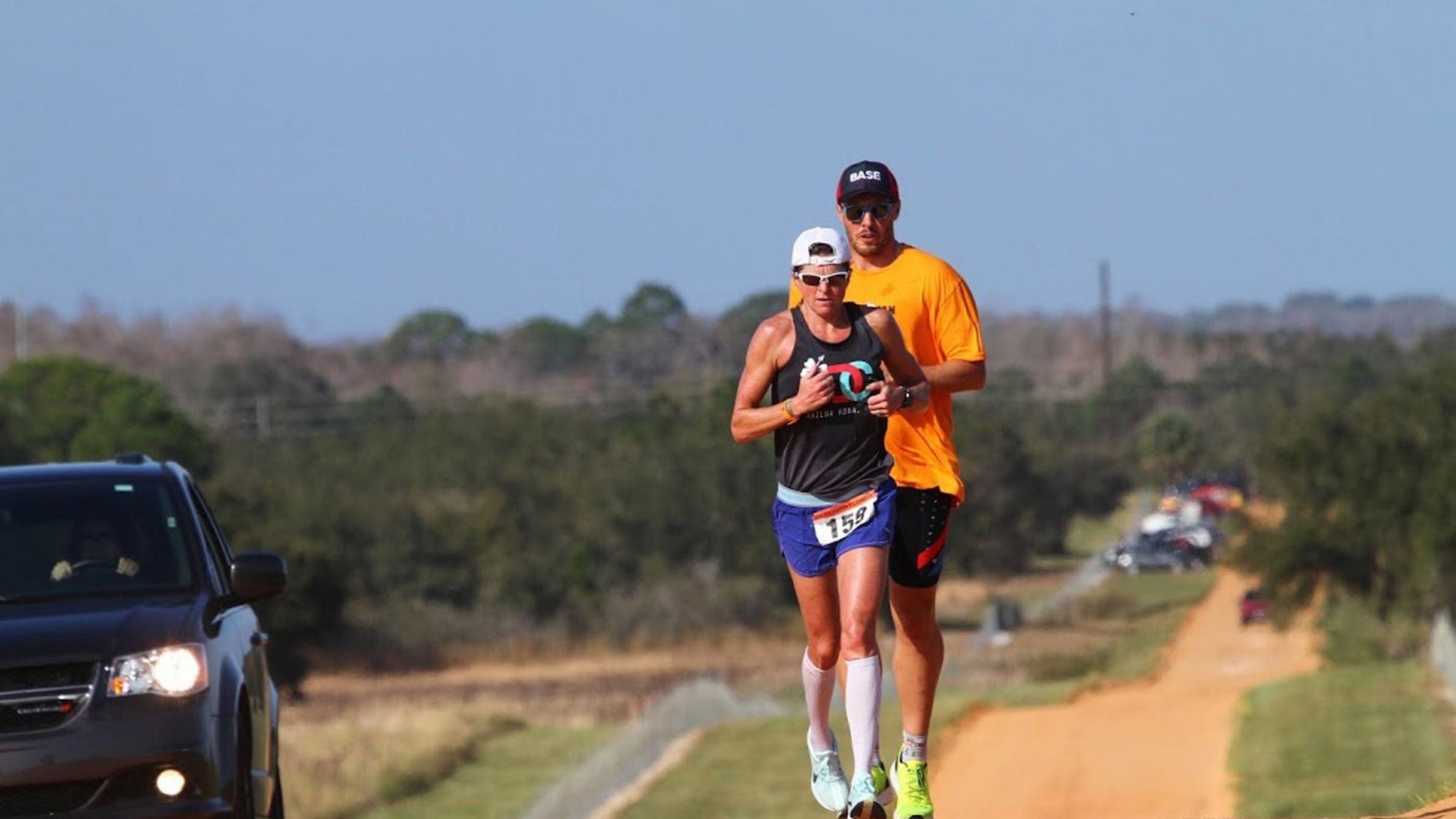
(Photo: Courtesy of Dede Griesbauer)
Since its debut in 1983, the Ultraman triathlon has remained one of the most niche events in endurance sports. Completing more than twice the distance of an Ironman over three days is hard enough to comprehend, but Ultraman has also intentionally avoided prize money.
With no major payouts to lure pros, the race attracts limited media attention and typically fields a much smaller roster than its shorter, flashier counterparts. Case in point: The Ultraman World Championship, a three-day, 320-mile test of endurance featuring a 6.2-mile swim and 90-mile bike on day one, a 171-mile bike on day two, and a 52.4-mile double marathon on day three, caps its entries at just 40 athletes, with participation by invitation only.
Yet Ultraman has quietly become one of the most enduring fixtures in the sport. More than four decades after this “odyssey of personal rediscovery” kicked off from the shores of Hawaii’s Big Island, the Ultraman World Championship, to be held November 28–30 this year, continues to uphold its original mission: to create a competition rooted in the guiding principles of Hawaiian culture – aloha (love), ʻohana (family), and kōkua (helpfulness) – in contrast to what event founders felt was Ironman’s growing corporate tilt.
Despite its intimidating scale and low-profile presence, Ultraman has steadily expanded, adding events in the U.K., Australia, Florida, and Canada. And while Ultraman champions may not command the same headlines as Ironman podium-toppers, their achievements are no less extraordinary.
ADVERTISEMENT
Here are five standout stories from Ultraman over the years.
2024: Moms take over Ultraman
In a historic finish, two pro triathletes – and moms – went one-two, with Canada’s Jen Annett outlasting Denmark’s Michelle Vesterby to become the first woman to win the race outright. Annett set an overall women’s course record (23:04:56), along with new marks for the day-two bike and day-three run. Both she and Vesterby finished nearly two hours ahead of the next competitor, Juan Bautista Castillia Arroyo.
While Annett’s win was groundbreaking, women excelling at Ultraman is nothing new. The distance has long narrowed the gender gap, much like in ultrarunning. The first woman to reach the overall podium was American Ardis Bow in 1985, and since then, five others – including Annett and Vesterby – have stood on the overall podium.
2022: Dede dominates
American pro triathlete and multi-time Ironman champion Dede Griesbauer tried her hand at the Ultraman distance and nearly won it outright. After debuting at Ultraman Florida in 2020, where she set a world-best time of 22:48:31, Griesbauer claimed the women’s world championship title in 23:22:58 at age 52, finishing less than 10 minutes behind overall winner Richard Thompson. The next woman, Israel’s Antonia Roznikov, finished more than 90 minutes back.
ADVERTISEMENT
2012: Ribeiro – and age – rules
Brazil’s Alexandre Ribeiro claimed his sixth Ultraman World Championship title, finishing more than three hours ahead of the runner-up. His six-title haul matched the benchmark set by American Shauna Armstrong, who won six times between 2003 and 2009. At 47, Ribeiro became the oldest winner in event history at the time, underscoring the success of masters athletes at Ultraman. Just one year later, 51-year-old Slovenian Milo Kregar was crowned the oldest champion.
2008: Adaptive athletes enter the chat
American Jason Lester became the first athlete with a disability to compete in and complete the Ultraman World Championship, paving the way for future paratriathletes, including American André Kajlich in 2014, the first wheelchair athlete to finish an Ultraman. (Earlier this year, Chris Nikic, the first athlete with Down syndrome to complete an Ironman, announced his goal to take on the distance as well.) In 2009, Lester received the ESPY Award for Best Male Athlete with a Disability, becoming the first male triathlete to earn the honor. In 2010, Lester and his friend Rich Roll, now a top podcaster (who raced the Ultraman World Championship in 2008 and 2009), completed the EPIC5 Challenge, finishing five Ironman-distance triathlons on five Hawaiian islands in less than a week.
1998: Spiegel speeds to long-standing record
Holger “Holgie” Spiegel, a 26-year-old German, set a course record with a finishing time of 21:41:22, a mark that stood for 25 years. While other athletes came close – Sweden’s Jonas Colting in 2004 (21:41:49), Alexandre Ribeiro in 2008 (21:49:38), and Canada’s Mike Coughlin in 2015 (21:44:18), among others – it wasn’t until 2023 that the record fell. With a 6:09:47 run on day three, Simon Cochrane shattered Spiegel’s record, becoming the first person to break 21 hours on the Ultraman course with a three-day total of 20:57:46.
