Updated February 10, 2026 12:03PM
Why 20 Meters Matters (And How Ironman Got There)
We take a deeper look inside Ironman’s data-driven decision to increase their professional draft zone from 12 to 20 meters.
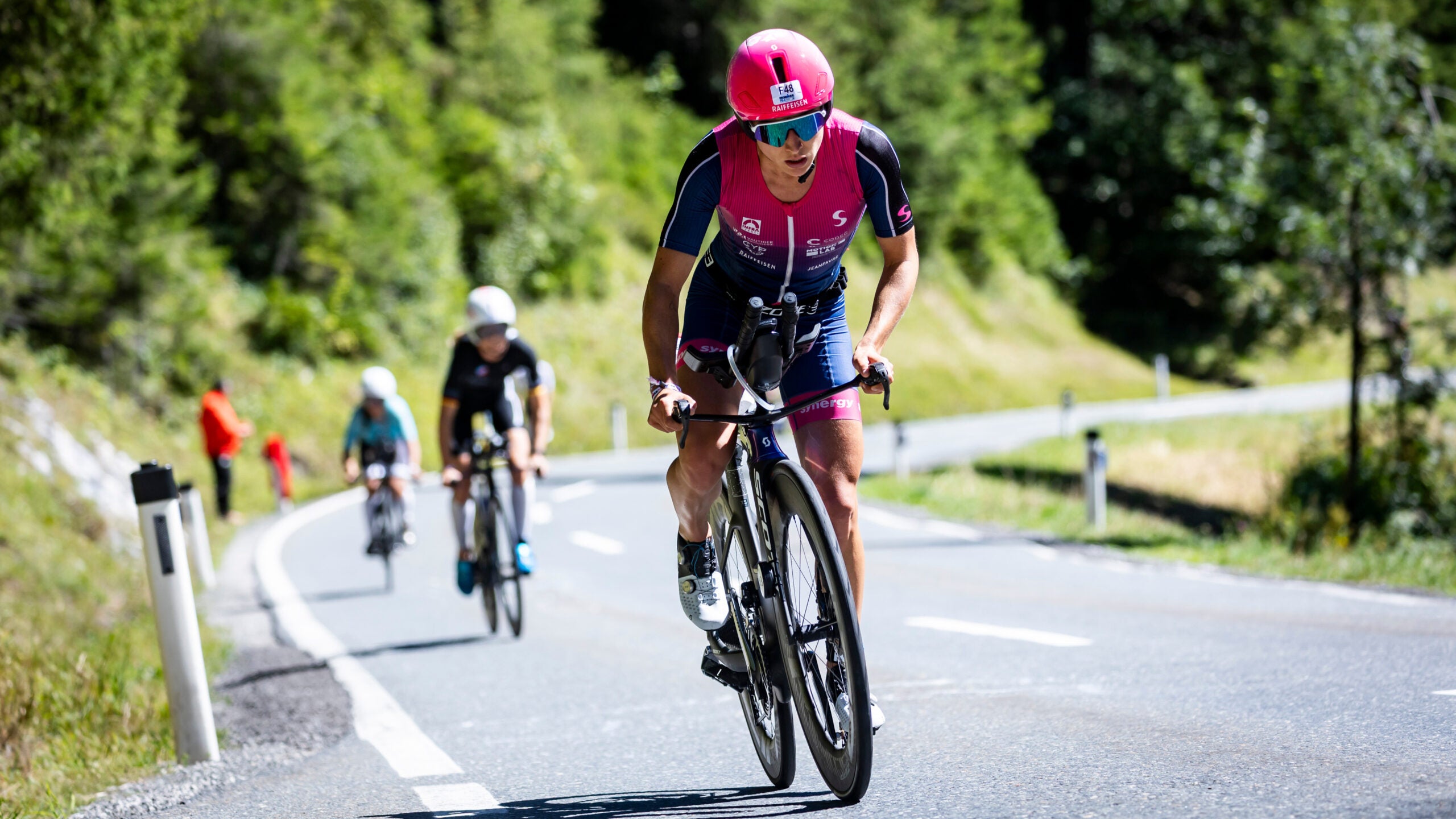
Former pro triathlete and aero nerd TJ Tollakson breaks down the importance of Ironman's change from 12 to 20-meter draft zones. (Photo: Ironman)
When Ironman announced on January 27 that the professional draft zone would expand from 12 meters to 20 meters beginning March 1, 2026, the reaction from elite athletes was immediate and largely unanimous: relief, validation – and a sense that Ironman had finally aligned its rules with what riders (and other race series) have intuited on the road for years.
The graphic itself was simple: Professional Draft Zone Distance to Be Increased to 20 Meters.
The process behind it was anything but.
What followed was Ironman’s own explanation involving what they say is one of the most comprehensive, transparent, and technically grounded rule changes professional triathlon has seen – rooted not in anecdote or athlete frustration alone, but in controlled field testing, aerodynamic measurement, and race-day realities.
ADVERTISEMENT
With only a select amount of raw data and transparency available at the time of announcement, we’ve tapped aerodynamics expert Marc Cote to give a quick primer on aerodynamics 101 and look at the challenges surrounding aerodynamic testing in real-world conditions. (Ed note: As Cote was not involved in the Ironman draft-zone testing process we can consider him an impartial expert; he will also only be speaking to his expertise in aerodynamics and testing in general.)
The longstanding problem with non-drafting racing
Since 2015, Ironman’s global competition rules have defined a 12-meter draft zone for professional racing. In theory, that distance was meant to preserve the integrity of a non-drafting bike leg while remaining practical enough to actually enforce in real time (highway lane markers in the U.S. are often spaced at 40 feet or 12.2 meters). However, in practice, many professionals argued it fell far short.
At modern race speeds, often exceeding averages of 28 miles per hour, athletes consistently reported that legally spaced groups still rode faster and more efficiently than solo riders. While this wasn’t traditional wheel-to-wheel drafting, like you’d see at the Tour de France, the aerodynamic interaction was tangible enough to influence race dynamics, pack formation, and ultimately results.
ADVERTISEMENT
For years, the debate lived in a gray area between perception and proof. Ironman once famously commissioned their world championship title sponsor, Ford Motors, to conduct draft testing – Ford concluded that seven meters was adequate enough to prevent a measurable advantage from drafting. The athletes in the races knew seven meters wasn’t nearly enough, but there was never any proof.
Moving beyond opinion
And then in mid-2025, Ironman committed publicly to a multi-phase draft-zone testing program in collaboration with draft technology startup RaceRanger and led by aerodynamic and electrical engineering expert Marc Graveline.
The goal was explicit. Determine whether different draft-zone distances produced meaningful changes in aerodynamic benefit and race behavior when professional athletes rode at actual race speeds and power outputs.
According to Ironman’s protocol, each athlete first completed baseline aerodynamic testing to establish an individual coefficient of drag. From there, controlled group tests were conducted outdoors, with bikes instrumented to measure power, speed, wind, air density, and road gradient. RaceRanger technology was used to hold precise following distances (as they would occur in a race situation) and track variability.
Crucially, riders rotated positions within groups to account for differences in body size and power, ensuring the data reflected group dynamics rather than the influence of any single athlete, Ironman said.
ADVERTISEMENT
Ironman said three distances were tested head-to-head under consistent conditions at 12 meters, 16 meters, and 20 meters.
What the data revealed
Ironman felt the findings were clear enough to support a decisive rule change that lined up with existing rules from pro long-course racing events like the T100 Tour and Challenge Family events.
Ironman says that at professional race speeds, increasing the draft zone from 12 to 16 meters did not produce a material reduction in aerodynamic benefit: Wake effects persisted, and watt savings remained substantial, particularly deeper in a group where drafting advantage compounded rather than diminished. But what, exactly, does all that mean?
Aerodynamics 101
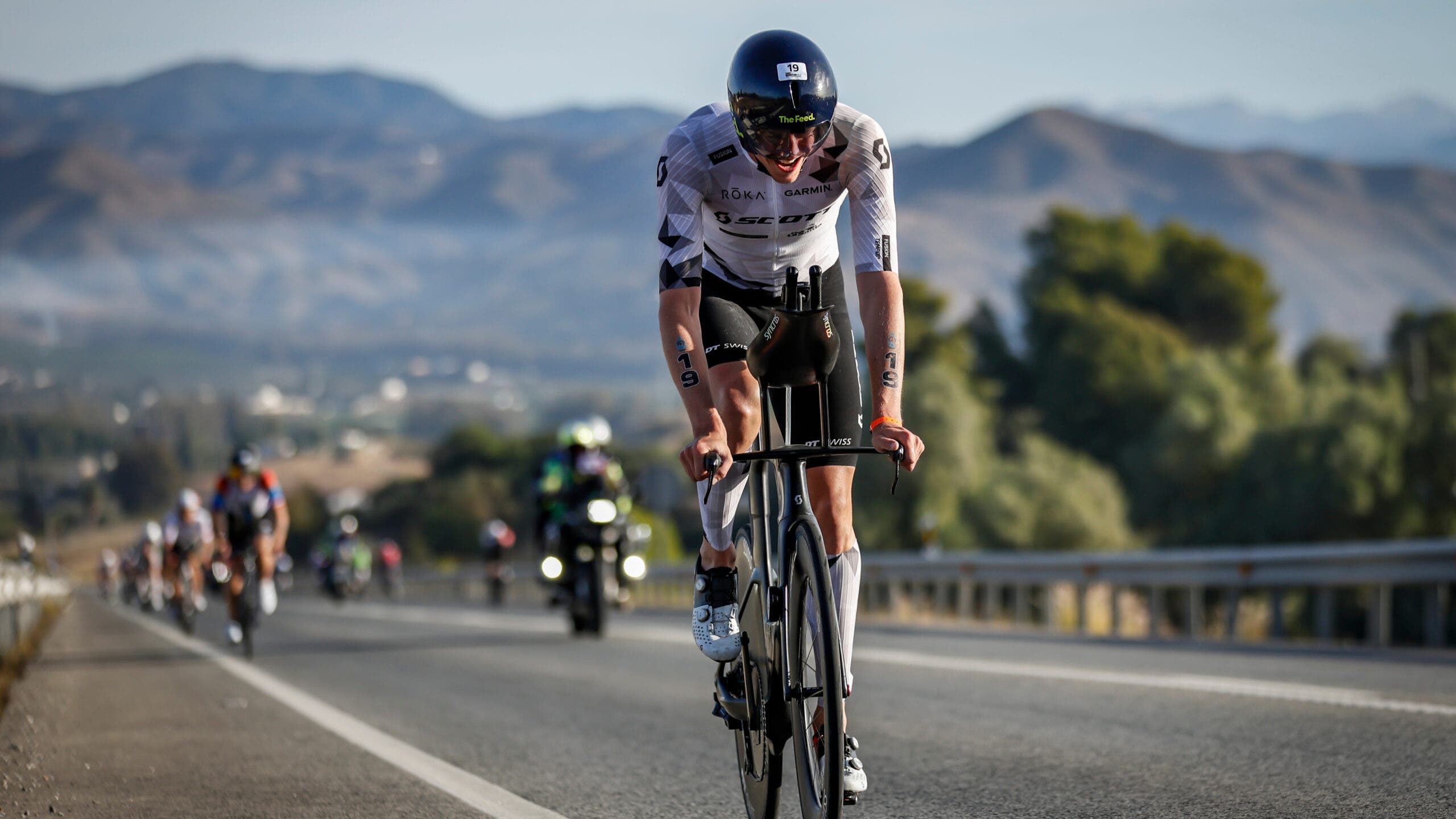
Mark Cote is a mechanical engineer with a degree from MIT who was the founder of the Specialized Win Tunnel in Morgan Hill, California. Mark worked with a Win Tunnel team for Specialized from 2007-2020 and conducted hundreds of low-speed aerodynamic tests. Here he explains aerodynamics to us like we’re 13:
ADVERTISEMENT
When a cyclist moves forward, they must displace the air in front of them. This process creates two distinct zones that affect any rider following behind:
1. The high-pressure front
As the lead rider “punches” through the air, a small pocket of high-pressure air builds up in front of them. Interestingly, a very closely drafting rider can actually push this high-pressure air forward, slightly reducing the workload for the leader – a phenomenon known as the pushing effect.
2. The low-pressure wake (The “Slipstream”)
Behind the lead rider, the air becomes turbulent and less dense. This area of low pressure is the “wake.”
- Reduced resistance: Because the air in the wake is already moving in the same direction as the riders, a following cyclist doesn’t have to work as hard to displace it.
- Energy savings: A rider positioned perfectly in this wake can reduce their power output by 20% to 40%, depending on the size of the group and wind conditions.
- Mark Cote conducted drafting testing at the Specialized Win Tunnel at a distance of eight meters and found a 10-15% reduction in wind speed hitting the rear rider.
Factors influencing wake stability
The shape and effectiveness of the wake aren’t static; they change based on several variables:
- Proximity: The closer the following rider’s front wheel is to the leader’s rear wheel, the more they remain within the “sweet spot” of the low-pressure zone.
- Wind angle (Yaw): In a direct headwind, the wake is directly behind the leader. In a crosswind, the wake shifts to the side, forcing the drafting riders to form an echelon (diagonal line) to stay protected.
- Velocity: Wake effects become significantly more pronounced as the cyclist’s speed increases. Since aerodynamic drag increases with the square of velocity, the energy saved by drafting at 40 km/h is far, far greater than at 20 km/h.
ADVERTISEMENT
Back to the Ironman testing…
The first distance that meaningfully altered the aerodynamic equation was 20 meters.
At that spacing, the low-pressure wake created by the lead rider had largely dissipated, reducing the incentive for cooperative riding and diminishing the pack amplification effect that has characterized many professional bike legs in recent years.
In short, 12 meters was too short and 16 meters was too small a change to matter.
ADVERTISEMENT
Twenty meters was the first distance that changed race dynamics in a meaningful way.
The clearest illustration that Ironman provided came from measured watt savings by rider position within a group. The shape of the data mattered more than the absolute values. The curve did not meaningfully flatten until 20 meters.
Weird data worth watching
One detail deserves closer attention:
At the 20-meter spacing, the third rider in the group showed greater watt savings than the second rider, while still saving more than the fourth and fifth riders. At first glance, that ordering appears counterintuitive: In a simplified drafting model of 20 meters, aerodynamic benefit would be expected to decrease with distance from the leading rider into the wind (as it does between riders four and five).
Real-world aerodynamics, however, are rarely that clean.
Cote notes, “Ultimately, there are a ton of factors in testing outdoors that could have more impact in the drafting distance.”
ADVERTISEMENT
Cote further explained that: “Without being able to repeat a test with a control and a standard deviation, we don’t know if these results are statistically significant or if they are just completely in the noise. When you add more riders into the mix, you just create more variability. We need to see the actual sensors used and the measured delta in the draft zone, rather than just an interpreted amount of power savings.”
To be clear: This weirdness doesn’t undermine the findings; the anomaly highlights the complexity of outdoor aerodynamic testing and reinforces why incremental spacing changes can fail to meaningfully alter outcomes.
This suggests further testing should extend beyond 20 meters to include 22 meters and 24 meters (and maybe even 26-meter) draft zones. Simply put, Ironman won’t know they’ve gone far enough – until they’ve gone too far.
Cote stated the largest problem with the dataset from Ironman was the lack of scale on the y-axis. “Without a scale of the y-axis, it is impossible to know if the watt saving is 1 watt or 100 watts.” More transparency in data surrounding the testing would benefit the scientists concerned with the difficulty in repeatedly measuring the drafting benefits in real-world testing.
ADVERTISEMENT
Why speed changed everything
One of the most important contextual factors is how much faster professional triathlon has become overall since the 12-meter rule was standardized a decade ago.
Advances in equipment, aerodynamics, and training have raised sustained bike speeds across the pro field. From a physics standpoint, aerodynamic drag scales with the square of speed. As velocity increases, wake persistence extends farther behind the lead rider, magnifying the benefit of even small reductions in drag. This is why standard bicycle testing in the wind tunnel is done at 30 mph, to show better resolution of the drag.
ADVERTISEMENT
A draft zone that may have been sufficient at 25 miles per hour behaves surprisingly differently at 28 or 30 miles per hour.
As Ironman’s findings made clear, the sport had effectively outgrown its own rule – like a toddler moving into a big-boy bed.
From physics to policy
Following the completion of testing, Ironman announced that the professional draft zone would increase to 20 meters for all Ironman and Ironman 70.3 professional races beginning March 1, 2026, with details codified in the upcoming competition rules update.
Importantly, this was not framed as a pilot or trial. The data was deemed sufficient to justify a permanent change (although even this permanence is somewhat temporary as more data is collected and analyzed).
According to Ironman CEO Scott DeRue, the decision reflects a broader organizational shift toward evidence-based governance. “We are actively using data and insights to drive decisions that will continue to provide a better athlete experience,” DeRue said during the announcement.
Professional athletes responded positively.
ADVERTISEMENT
Ironman 70.3 champion and 2017 70.3 World Championship runner-up Ben Kanute emphasized both the rigor of the process and the importance of clarity. “Well done for doing testing, making a decision quickly, and implementing it,” Kanute wrote. “Rule changes don’t always happen fast, and as an athlete having clarity well before the races start is key.”
Conversely, Challenge Family – a pro long-course race series that introduced a 20-meter drafting in 2014 – not-so-subtly congratulated itself on setting “…the standard for fairer racing,” in an email press release only hours after Ironman’s own announcement.
“Today marks a milestone for the sport. Earlier this afternoon, DATEV Challenge Roth announced it would implement a 20-meter drafting zone following extensive consultation with professional athletes,” the Challenge email said. “Shortly after, Ironman also confirmed today that it will move from a 12-meter to a 20-meter drafting zone for all its professional races over the 140.6 and 70.3 distances.”
“We are proud to see our 20-meter drafting rule being embraced by other leading organisations,” added Jort Vlam, Challenge Family CEO.
ADVERTISEMENT
How the rule will be enforced
Expanded spacing naturally raises questions about enforcement.
Ironman addressed this directly by saying that RaceRanger will be used at nearly all professional races, but it will remain a “decision support tool” rather than an automated referee system. Drafting penalties will continue to be assessed by human officials, with RaceRanger data informing calls rather than independently triggering them.
ADVERTISEMENT
This approach preserves athlete due process while reducing subjectivity, particularly in dense race scenarios where visual judgment alone has historically been inconsistent.
Why age-group rules remain the same
While professionals move to a 20-meter draft zone, age-group athletes will continue racing under the existing 12-meter rule.
Mark Cote, himself a five-time Ironman age-group finisher noted, “From a raw aerodynamic standpoint, there’s no reason why an age-group and pro rule shouldn’t be the same, but from a practicality standpoint, it’s going to be difficult to [use a 20-meter draft zone] for all age groupers.”
Ironman says it will continue to monitor the age group race dynamics and the data to determine future rule changes.
ADVERTISEMENT
A call for continued transparency
The move to 20 meters is a meaningful step forward, but the data itself makes a compelling case for continued testing and greater transparency.
During the announcement, DeRue noted that fewer than 20 professional athletes participated in the testing program, but did not specify the exact number, nor the range of rider sizes, equipment configurations, or course conditions used.
ADVERTISEMENT
Cote applauded Ironman for taking a data-first approach but voiced some concerns from interested scientists. “I’m not calling for more transparency personally, but after reading the comments, it seems like (other) scientists want more information, but the pros are pretty happy that a study happened and the rule changed.”
For a sport increasingly guided by measurement, this is a step in the right direction.