Published January 22, 2024 06:00AM
Triathlon Training Actually Reshapes Your Brain. So, Can We Make Our Minds More Aero?
Neuroscientist Dr. Daya Grant explains how endurance training literally alters the structure of the brain.
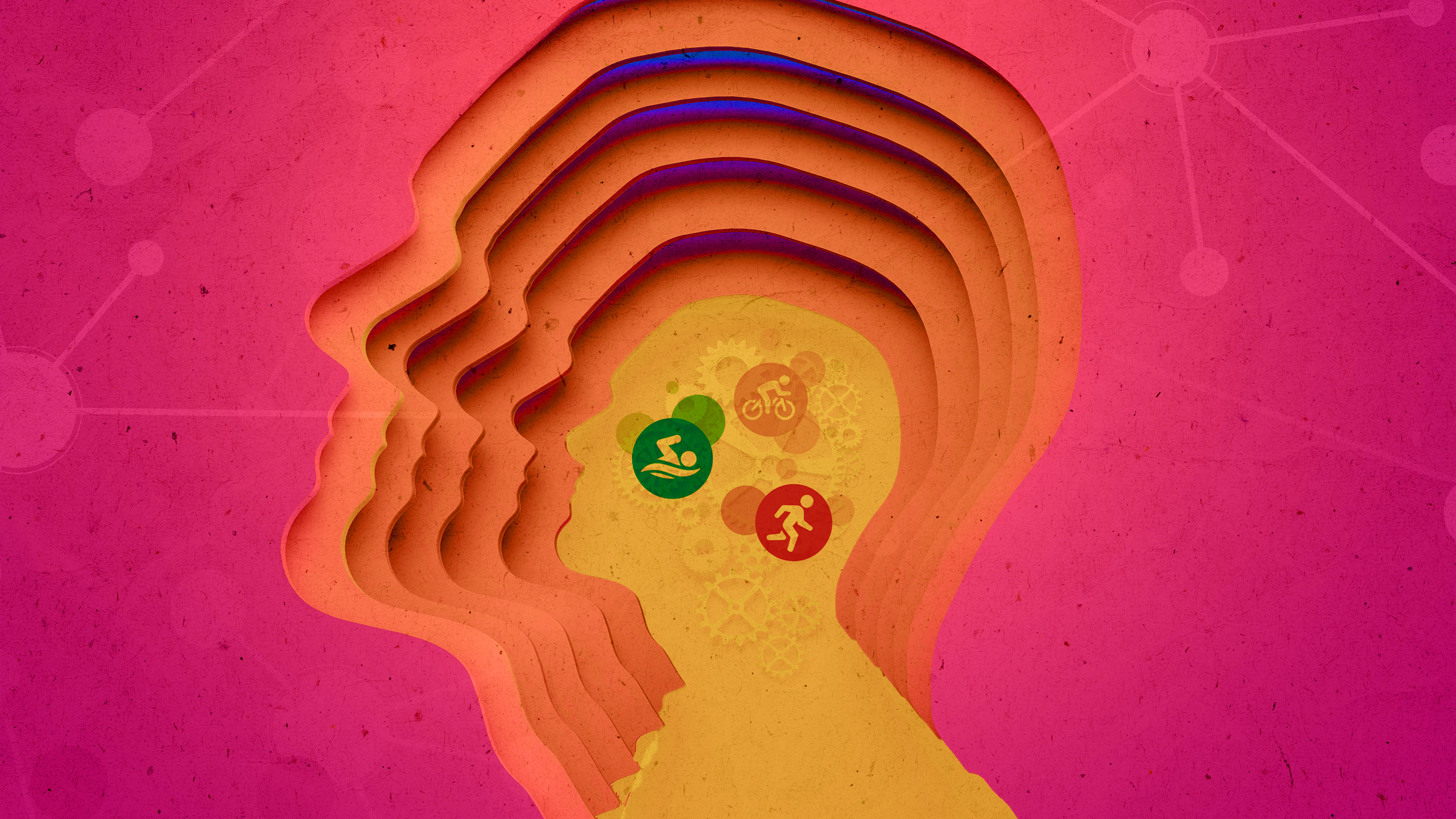
As it turns out, endurance training has just as many benefits for the body as it does the brain. (Photo: Triathlete)
As triathletes, we all want to go faster—increased distance per stroke, more watts per pedal, and a more efficient stride. We buy wetsuits to make us more buoyant and glide through the water quicker; we buy bikes and wheels and helmets that slip through the wind better; we even buy supershoes to help with energy return on the run. But what if we could make the stuff inside our skulls stronger and more efficient…even faster?
It is well understood that physical activity, especially aerobic exercise, changes the brain. We see these changes most often psychologically—by observing behavior—or physiologically—by measuring the amount of notable molecules in the brain. But, what about physical changes to the brain itself? Is it possible that endurance training alters the structure of the brain? Can we make our brain more “aero?”
Neuroscientists have begun exploring how training reshapes the brain, and while the research is very much in its infancy, some interesting findings have already emerged.
The endurance athlete’s brain: Macrostructural differences
One way to assess structural differences between endurance athletes and healthy controls is to look at the brain’s macrostructure. This level of analysis compares differences in the volume of brain tissue, including both gray matter volume and white matter volume.
ADVERTISEMENT
Gray matter
Gray matter makes up 40% of the brain and includes neuronal cell bodies and dendrites, which are little protrusions that enable communication with neighboring cells to aid in controlling movement, memory, and emotions. A recent study found that young endurance athletes, ranging in age from 18-40, had less gray matter volume compared to non-athletes. The authors noted that the characteristics of the endurance athlete’s brain are typical of a more mature brain that has undergone synaptic pruning, a process by which lesser utilized synapses (i.e. connections between brain cells) are eliminated. This results in more efficient brain networks and more optimal brain function—so in a way, more “mentally aerodynamic.”
In another study, older, long-term endurance athletes were compared against healthy controls who met, but didn’t exceed, physical activity guidelines per the American College of Sports Medicine (ACSM). Interestingly, this comparison between older athletes revealed greater cortical thickness (i.e. increased gray matter volume), suggesting that age is an important variable to consider when assessing macrostructural changes.
White matter
Beneath the gray matter lies the white matter, which makes up a slight majority of the brain tissue, at 60%. White matter is composed of bundles of axons, which are nerve fibers that communicate with more distant regions of the brain and spinal cord and allow for better communication between different areas of the brain. White matter volume is similar between older endurance athletes and healthy controls, but it is greater among younger endurance athletes, compared with age-matched controls. To understand why this may be the case, we have to look closer at the structure of the axonal bundles themselves.
ADVERTISEMENT
The endurance athlete’s brain: Microstructural differences
Microscopic structural differences (let’s refer to these as microstructural differences) consist of changes to the white matter fibers, or bundles of fibers called tracts. Modifications to the brain tissue itself are relevant because this helps determine overall brain health and functionality. Neuroscientists across multiple studies have analyzed fiber tracts and observed microstructural differences in a variety of areas.
Younger endurance athletes (averaging in their mid to late 20’s) showed higher myelination in several tracts, including the corpus callosum, which connects the right and left hemispheres of the brain, and the inferior occipito-frontal fascicle, which helps integrate sensory and motor information. Higher myelination (note: myelin is the “insulation” around nerve cells) might suggest faster processing speed, a likely benefit for triathletes needing to process large amounts of incoming information while moving pretty quickly (think: adjusting your stroke rate or breathing in a crowded swim with large waves, or steering your bike through a crowded aid station while grabbing a water bottle).
Myelin decreases as we age, which is considered to be a key factor in age-related cognitive decline. But older endurance athletes showed higher myelination in some overlapping tracts, as well as the superior corona radiata and the superior longitudinal fasciculus, which are involved with motor control and coordination.
ADVERTISEMENT
Endurance training’s effect on the brain
There is no doubt that endurance training changes the brain. The specific effect on gray and white matter volume (macrostructure), as well as white matter integrity (microstructure), seems to be somewhat dependent on the age of the athlete. These changes may indicate higher processing speeds or better motor control and coordination. There remains a lot to uncover in terms of implications for training, racing, and recovery, but one thing is certain: The brain benefits from those swim, bike, and run workouts as much as the body.