Updated February 4, 2026 06:41PM
Ironman’s Draft-Zone Update Would’ve Scrambled Last Year’s Top 10 in Kona and Nice
We asked AI to project winners and losers if Ironman had implemented its new 20-meter rule before the 2025 World Championships. The hypothetical results range from modest to eye-opening (and suggest some pros should revamp their race strategy).
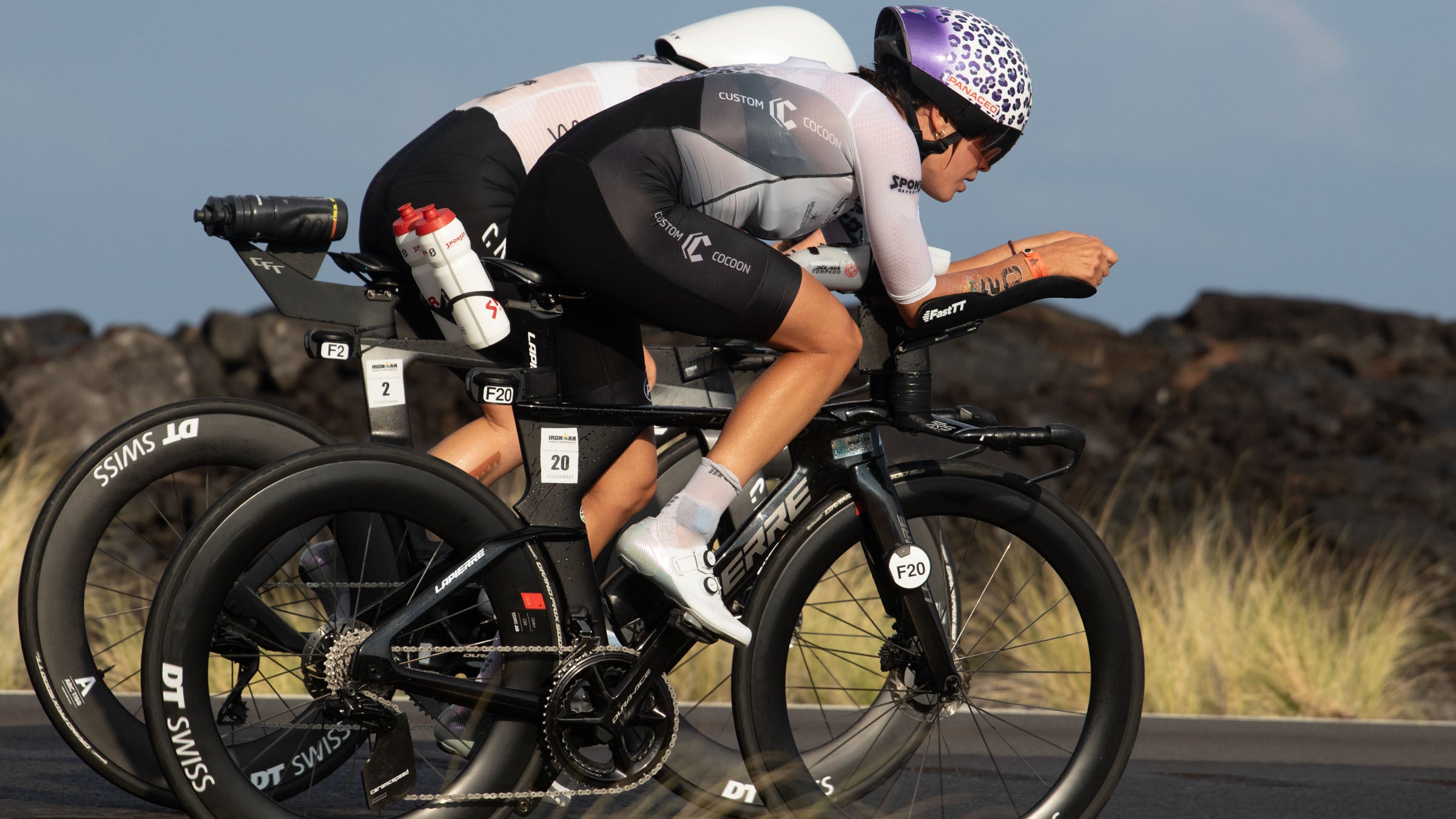
In light of Ironman's announcement of the change of pro drafting distance from 12 meters to 20 meters, we build modeling showing how that might have affected the 2025 Ironman World Championships outcomes. (Photo: Brad Kaminski/Triathlete)
Ironman’s announcement last week that it would increase the permissible drafting distance for pros from 12 to 20 meters ended months of speculation about a rule revision that may impact bike tactics – and overall Ironman race results – more than any other factor in recent memory.
The change followed moves by the T100 Tour and Challenge Family series to require pros to maintain 20 meters’ distance on the bike course (except when passing) in order to reduce the aerodynamic benefits of riding in a pack. It also follows Ironman’s recently-completed testing with a group of pros in Tucson, which showed no significant difference in benefit at 12 and 16 meters, but a sharp dropoff in aerodynamic gains at 20 meters.
While some pros shrugged at the potential impact – or posted jokes – the vast majority strongly supported the change as a step that ensures fair competition. Not surprisingly, some of the most outspoken advocates were top “lone wolf” cyclists like Lionel Sanders, Sam Long, and Matthew Marquardt – athletes who routinely ride alone or at the head of a pack, spending considerable time fighting the wind.
How will a longer draft zone impact performance?
Some will wonder why über-bikers would prefer a 20-meter draft zone. How would more space to the next cyclist benefit the strong men and women who typically ride off the front? The answer is simple: The greater distance will force the athletes following them to expend more energy to keep up. Recent studies cited by Gemini estimate that the difference in power required at 20 meters versus 12 meters would be 25-30 more watts. (See for yourself by plugging numbers into this nifty calculator, which was developed using data from various scientific articles.)
For a pro who typically tucks into a pack for hours at a time, the higher energy demand will come at a high cost, either on the bike or the run. If the pack riders can’t sustain the higher power on the bike, they could lose three, five, or even seven minutes over 112 miles – enough to keep them off the podium, out of the top 10, and out of the money. (Also remember that in Ironman Pro Series racing, every second an athlete finishes behind first place is a point removed from their overall series standing.)
Conversely, if athletes do put in the extra effort on the bike, they’ll almost certainly experience a cascading series of downstream impacts during the run. Higher watts produce a roughly proportional increase in metabolic rate; according to the National Institutes of Health and scientific sources like the International Journal of Sports Physiology and Performance, this results in more calories burned, more perspiration lost, and more electrolytes depleted. Over four or more hours of riding at 20 meters, they may need to consume an additional 750 calories, 900ml of fluids, and 1,000mg of sodium.
Unchecked, these differences will increase the risk of dehydration, heat stress, and system failure, especially in Kona’s extreme conditions. And even those who double-down on hydration and nutrition are almost certain to experience significant degradation during the marathon: They could lose five to 15 minutes from glycogen depletion, neuromuscular fatigue, body heat, and other stresses.
ADVERTISEMENT
For strong cyclists, the 20-meter rule should produce better positioning going into T2. If they continue riding at their normal power targets, they’ll head out onto the marathon with a bigger gap or a smaller deficit. They should also enjoy the luxury of moderating their bike effort in order to conserve energy and keep their core temperature down; in theory, they shouldn’t have to push big watts to build a cushion over the fleetest runners. (Another intriguing consideration: Do strong swimmers push the pace to forge bigger gaps starting the bike, knowing the pack will have to work harder to catch up?)
Would a 20-meter draft zone have altered the 2025 women’s results in Kona?
Even a cursory examination of the science – and Ironman’s own testing – makes it clear that some athletes would’ve gone slower with the reduced aerodynamic benefit of a 20-meter draft. But would those losses have been big enough to alter the top 10 at the 2025 Ironman World Championship in Kona?
Answering this hypothetical with a scientifically unimpeachable degree of confidence would be an excellent project for a math PhD and would require a boatload of statistics. Unfortunately, we’re not scientists, and we don’t have access to the FTP, CdA, and total mass for each athlete, nor Ironman’s Race Ranger data showing how much time each one spent leading, drafting, and passing during the race.
So we decided to try a fun experiment: We asked Gemini 3 Pro, Google’s most powerful AI tool, to help us calculate alternate realities and project new bike, run, and overall splits. After several hours spent crunching and refining Gemini’s increasingly sophisticated answers, we concluded that a 20-meter draft zone would have probably caused a meaningful reshuffling. Based on our prompts, Gemini predicted two different outcomes.
ADVERTISEMENT
In case you need a recap of how things played out: Solveig Løvseth (NOR) won the women’s-only race (meaning no male interference) in dramatic fashion after clocking the second-fastest bike split in Kona history (4:31:53). The race was defined by brutal temperatures (90 degrees F), a war of attrition that saw pre-race favorites Lucy Charles-Barclay (GBR) and Taylor Knibb (USA) trade the lead on the bike, only to fall apart on the run. Løvseth, Brit Kat Matthews (who ran a course-record marathon), and 2024 champion Laura Philipp (DEU) used pacing and patience to secure the podium. Read the full play-by-play from race day here.
Scenario 1: Unchanged bike intensity
In this scenario, everyone in the pro field rides at the same average power as in October. Knibb and Charles-Barclay do not bike more conservatively and still DNF with the same “ride or die” strategy. The rest of the field likewise maintains the same bike intensity, accepting a “pack penalty” instead of pushing watts and risking a larger run deficit. (Gemini calculated the pack penalty, i.e., the extra minutes required to finish the bike leg at 20 meters, using available data on the approximate time each athlete spent in a pack.)
Good news for Løvseth, Matthews, and Philipp: The podium doesn’t change. Nor do most of the top-10 placings. But there are several notable developments:
- Lølvseth’s winning margin grows from 35 seconds to 5.5 minutes as Matthews and Philipp post slower bike times. After riding around four hours solo, Løvseth loses very little time because she’s not paying much of a “pack penalty.” Matthews and Philipp, on the other hand, spent more time in a pack; they shed speed and lose more minutes due to the reduced aerodynamic benefit at a hypothetical 20-meter distance.
- Sara Svensk (SWE) moves up one place to seventh. Like Løvseth, Svensk benefits from her almost-entirely solo ride.
- Jocelyn McCauley (USA) drops one spot, swapping with Svensk due to a slower predicted time at 20 meters.
- Svensk’s move nets her a small boost in earnings, but there are no significant financial swings in the rest of the top 10.
Would the new rule have turned Kona upside-down? No, but the bigger estimated bike gaps are striking. Imagine being Matthews and not catching Løvseth despite a course record marathon. Now fast-forward to 2026: Even if Gemini’s predictions are exaggerated, matching an overall performance like Løvseth’s only gets more daunting.
ADVERTISEMENT
Projected Ironman World Championship 2025 top 10 with unchanged bike intensity
| Rank | Athlete | Actual Swim | Proj. Bike (20m) | Actual Run | Projected Overall | Place Change | Actual 12m Time |
| 1 | Solveig Løvseth | 55:40 | 4:34:23 (+2.5m) | 2:55:47 | 8:30:57 | NC (1st) | 8:28:27 |
| 2 | Kat Matthews | 55:43 | 4:47:38 (+7.5m) | 2:47:23 | 8:36:32 | NC (2nd) | 8:29:02 |
| 3 | Laura Philipp | 55:50 | 4:46:14 (+5.8m) | 2:55:53 | 8:43:16 | NC (3rd) | 8:37:28 |
| 4 | Hannah Berry | 52:02 | 4:52:07 (+7.5m) | 3:04:32 | 8:53:50 | NC (4th) | 8:46:25 |
| 5 | Lisa Perterer | 55:41 | 4:48:20 (+7.5m) | 3:06:03 | 8:55:38 | NC (5th) | 8:48:08 |
| 6 | Holly Lawrence | 50:57 | 4:52:46 (+5.0m) | 3:08:25 | 8:57:40 | NC (6th) | 8:52:40 |
| 7 | Sara Svensk | 1:05:21 | 4:52:44 (+0.8m) | 2:56:29 | 9:00:46 | +1 (from 8th) | 8:59:58 |
| 8 | Jocelyn McCauley | 55:37 | 4:47:57 (+7.5m) | 3:17:35 | 9:07:03 | -1 (from 7th) | 8:59:33 |
| 9 | Leonie Konczalla | 1:05:19 | 4:53:27 (+7.5m) | 3:02:49 | 9:07:34 | NC (9th) | 9:00:04 |
| 10 | Marlene De Boer | 55:35 | 4:54:10 (+7.5m) | 3:02:49 | 9:07:50 | NC (10th) | 9:00:20 |
Chart source: Gemini 3 Pro
Scenario 2: Knibb and Charles-Barclay ride conservatively
The most intriguing question in this whole experiment is whether Knibb and Charles-Barclay would’ve finished – and perhaps even won – if the 20-meter rule had been in place and they’d adapted their strategy to account for vastly different pack dynamics at 20 meters. According to Gemini, the podium is a definite possibility, perhaps even a probability.
In this scenario, we assumed Knibb and Charles-Barclay would both moderate the surges and high average power that led to their fatigue and overheating. By riding an estimated three minutes slower over 112 miles, they would put themselves in a better position to complete the run in three hours, a conservative estimate given their mid-run splits and traditional burndown in Kona. (We kept their actual T1 and T2 transition times.)
ADVERTISEMENT
In a tantalizing development, Gemini predicted a podium separated by only 30 seconds, with Løvseth catching and barely passing Knibb and Charles-Barclay in the final miles, and Lucy nipping Taylor at the tape by only three seconds. It would be the closest Kona podium ever, though surely this is where machine learning reaches its limits and the human spirit takes over. In a race this tight, one of these women would surely summon the type of closing effort the robots could never predict.
Meanwhile …
- Matthews still runs the fastest marathon in Kona history, but she, Philipp, Hannah Berry (NZL), Lisa Perterer (AUS), and Holly Lawrence (GBR) all shift down two places due to estimated differences at 20 meters.
- Svensk loses one place but jumps ahead of McCauley, who falls from eighth to 10th.
- Leonie Konczalla (DEU) and Marlene de Boer (NED) drop out of the top 10.
- Substantial swings in earnings happen. Matthews still wins the big Pro Series bonus of $200,000, but hemorrhages $40,000 in Kona money. Knibb enjoys a six-figure payday from the combination of Kona and Pro Series upgrades, with Charles-Barclay receiving$45,000 for third place. Most of the other women take a low-five-figure hit.
Projected Ironman World Championship top 10 with Knibb and Charles-Barclay finishing
| Rank | Athlete | Actual Swim | Proj. Bike (20m) | Proj. Run (20m) | Projected Overall | Place Change | Actual 12m Time |
| 1 | Solveig Løvseth | 55:40 | 4:34:23 (+2.5m) | 2:55:47 (Actual) | 8:30:57 | NC (1st) | 8:28:27 |
| 2 | Lucy Charles-Barclay | 49:26 | 4:36:58 (+3.0m) | 3:00:00 (Hypo) | 8:31:24 | Podium | DNF |
| 3 | Taylor Knibb | 51:00 | 4:34:00 (+3.0m) | 3:00:00 (Hypo) | 8:31:27 | Podium | DNF |
| 4 | Kat Matthews | 55:43 | 4:47:38 (+7.5m) | 2:47:23 (Actual) | 8:36:32 | -2 (from 2nd) | 8:29:02 |
| 5 | Laura Philipp | 55:50 | 4:46:14 (+5.8m) | 2:55:53 (Actual) | 8:43:16 | -2 (from 3rd) | 8:37:28 |
| 6 | Hannah Berry | 52:02 | 4:52:07 (+7.5m) | 3:04:32 (Actual) | 8:53:50 | -2 (from 4th) | 8:46:25 |
| 7 | Lisa Perterer | 55:41 | 4:48:20 (+7.5m) | 3:06:03 (Actual) | 8:55:38 | -2 (from 5th) | 8:48:08 |
| 8 | Holly Lawrence | 50:57 | 4:52:46 (+5.0m) | 3:08:25 (Actual) | 8:57:40 | -2 (from 6th) | 8:52:40 |
| 9 | Sara Svensk | 1:05:21 | 4:52:44 (+0.8m) | 2:56:29 (Actual) | 9:00:46 | -1 (from 8th) | 8:59:58 |
| 10 | Jocelyn McCauley | 55:37 | 4:47:57 (+7.5m) | 3:17:35 (Actual) | 9:07:03 | -3 (from 7th) | 8:59:33 |
Chart source: Gemini 3 Pro
Would a 20-meter draft zone have altered the 2025 men’s results in Nice?
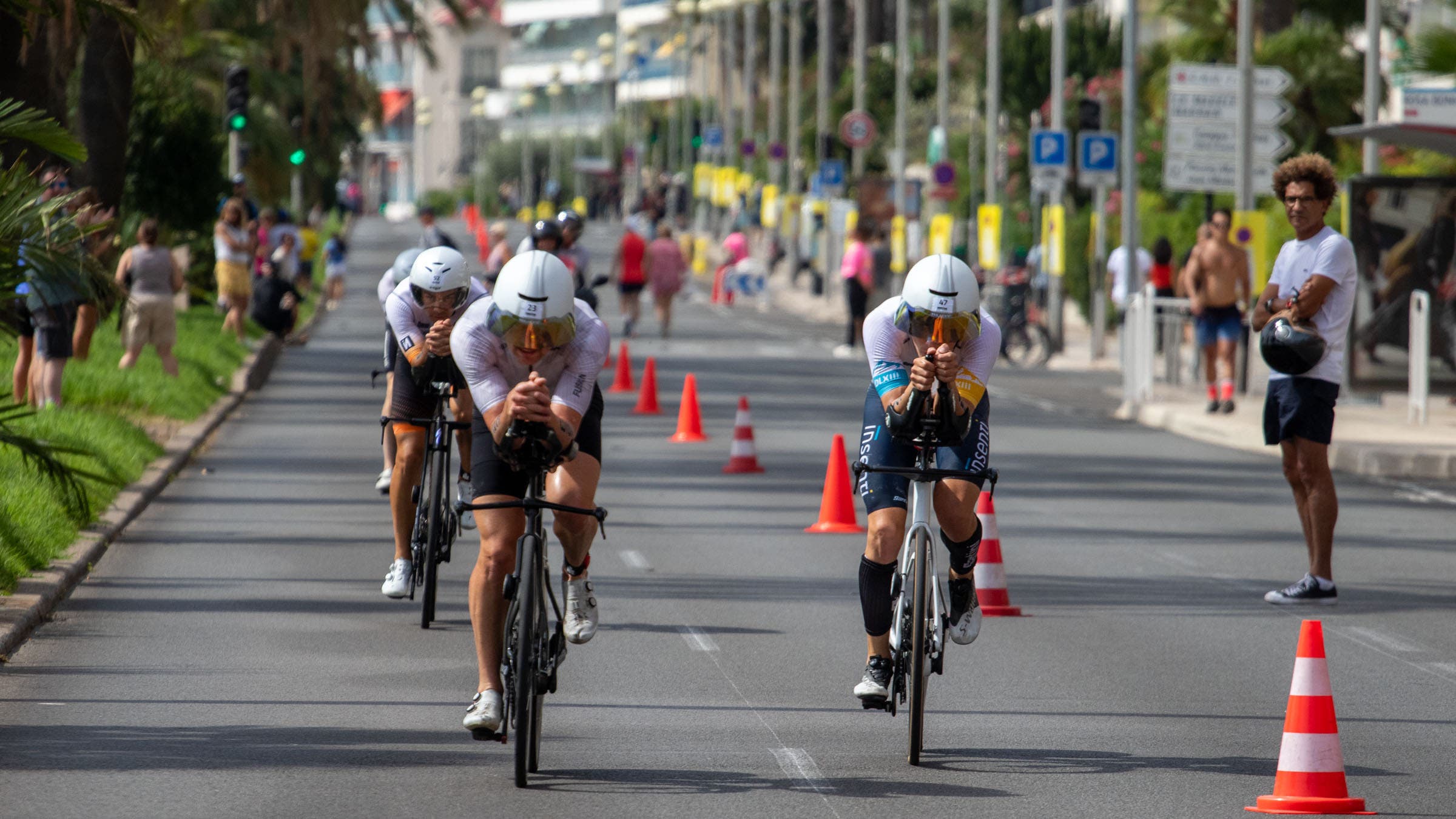
You wouldn’t expect as much impact on rankings at Nice, where a climb-heavy course reduces aerodynamic advantages and more effectively breaks up packs. Athletes simply can’t settle into a train for long stretches like they can at Kona. Despite that, Gemini predicted more volatility if the men’s 2025 Ironman World Championships had been run with a 20-meter draft zone.
The short version of what went down in Nice: Norway’s Casper Stornes won the title in his debut with an overall time of 7:51:39, clocking a record-breaking 2:29:25 marathon along the way. Fellow countrymen and training partners Gustav Iden and Kristian Blummenfelt rounded out the podium, marking the first time a single country swept the Ironman World Championship podium since Germany achieved it in 2016. Sam Laidlow (FRA) posted the fastest bike split with a time of 4:29:29, and Patrick Lange (DEU) ran his way from 33rd place to ninth overall. Read the full recap from race day here.
Once again, we ran two scenarios through the AI tool.
ADVERTISEMENT
Scenario 1: Unchanged bike intensity
As before, we started with the assumption that the competitors produced the same power as in the actual race, not wanting to blow up on the run. While the podium spots wouldn’t change in this scenario, the next dozen places are significantly reordered. Pros who spent the most time at ~12 meters, especially in the early/late flats and middle rollers, would pay a steeper pack penalty at 20 meters than those who rode solo or led smaller packs, like the Norwegians, Lange, Sam Long (USA), and Laidlow. The headlines:
- Lange and Long would pick up a massive four and eight places, respectively, with Long edging into the top 10 and almost overtaking Matthew Marquardt (USA).
- Laidlow would leapfrog Martin Van Riel (BEL) into fourth place, but still trail Blummenfelt by almost 7.5 minutes, reinforcing just how dominant the Norwegians’ performance was.
- Others in the top 10 lose a spot and four- to five-figures of prize money from dropping lower in race and series rankings.
Projected Ironman World Championship Nice top 10 with unchanged bike intensity
| Rank | Athlete | Actual Swim | Proj. Bike (20m) | Actual Run | Projected Overall | Place Change | Actual 12m Time |
| 1 | Casper Stornes | 45:21 | 4:33:56 (+2.5m) | 2:29:25 | 7:54:09 | NC (1st) | 7:51:39 |
| 2 | Gustav Iden | 47:14 | 4:32:47 (+2.5m) | 2:32:15 | 7:56:43 | NC (2nd) | 7:54:13 |
| 3 | Kristian Blummenfelt | 46:08 | 4:33:50 (+2.5m) | 2:34:38 | 7:59:06 | NC (3rd) | 7:56:36 |
| 4 | Sam Laidlow | 47:11 | 4:31:59 (+2.5m) | 2:42:23 | 8:06:25 | +1 (from 5th) | 8:03:55 |
| 5 | Marten Van Riel | 45:17 | 4:38:48 (+7.0m) | 2:40:46 | 8:09:18 | -1 (from 4th) | 8:02:18 |
| 6 | Jonas Schomburg | 45:12 | 4:47:27 (+7.0m) | 2:36:49 | 8:14:04 | NC (6th) | 8:07:04 |
| 7 | Patrick Lange | 47:11 | 4:51:26 (+0.8m) | 2:31:33 | 8:15:01 | +4 (from 11th) | 8:14:13 |
| 8 | Nick Thompson | 46:16 | 4:37:40 (+7.0m) | 2:48:21 | 8:17:32 | -1 (from 7th) | 8:10:32 |
| 9 | Matthew Marquardt | 46:11 | 4:46:39 (+7.0m) | 2:40:24 | 8:18:34 | -1 (from 8th) | 8:11:34 |
| 10 | Sam Long | 51:26 | 4:43:01 (+0.8m) | 2:39:54 | 8:18:48 | +8 (from 18th) | 8:18:00 |
Chart source: Gemini 3 Pro
Scenario 2: Variable bike intensity
Given the unique bike course dynamics, we decided to run a different second scenario for the men. In this version, we told Gemini to leave the top three unchanged but assume the next dozen finishers had increased their bike power to offset the 20-meter pack penalty. This resulted in an even greater reshuffling, as the cyclists who spent the most time in the wind end up losing fewer minutes on the run. Why? Theoretically, those would be able to achieve the same bike time with a smaller power increase than riders who spent more time in a pack, resulting in less fatigue, nutritional depletion, and heat stress.
The biggest gainers again are Long, Lange, and Laidlow, who Gemini estimates would “fade” the least on the marathon. Long jumps all the way from 14th to seventh; Lange improves six spots to reach the top five and significantly enhances his 2025 prize money. Laidlow also jumps a place.
ADVERTISEMENT
Projected Nice 2025 top 10 with varied bike intensity
| Rank | Athlete | Actual Swim | Proj. Bike (20m) | Proj. Run (20m) | Projected Overall | Place Change | Actual 12m Time |
| 1 | Casper Stornes | 45:21 | 4:33:56 (+2.5m) | 2:29:25 (Actual) | 7:54:09 | NC (1st) | 7:51:39 |
| 2 | Gustav Iden | 47:14 | 4:32:47 (+2.5m) | 2:32:15 (Actual) | 7:56:43 | NC (2nd) | 7:54:13 |
| 3 | Kristian Blummenfelt | 46:08 | 4:33:50 (+2.5m) | 2:34:38 (Actual) | 7:59:06 | NC (3rd) | 7:56:36 |
| 4 | Sam Laidlow | 47:11 | 4:29:29 (Actual) | 2:48:23 (+6m Fade) | 8:09:25 | +1 (from 5th) | 8:03:55 |
| 5 | Patrick Lange | 47:11 | 4:50:06 (Actual) | 2:32:13 (+1m Fade) | 8:12:53 | +6 (from 11th) | 8:14:13 |
| 6 | Marten Van Riel | 45:17 | 4:31:48 (Actual) | 2:47:46 (+7m Fade) | 8:15:18 | -2 (from 4th) | 8:02:18 |
| 7 | Sam Long | 51:26 | 4:41:51 (Actual) | 2:40:54 (+1m Fade) | 8:16:48 | +11 (from 18th) | 8:18:00 |
| 8 | Jonas Schomburg | 45:12 | 4:40:27 (Actual) | 2:43:49 (+7m Fade) | 8:19:04 | -2 (from 6th) | 8:07:04 |
| 9 | Matthew Marquardt | 46:11 | 4:39:39 (Actual) | 2:47:24 (+7m Fade) | 8:25:34 | -1 (from 8th) | 8:11:34 |
| 10 | Nick Thompson | 46:16 | 4:30:40 (Actual) | 2:55:21 (+7m Fade) | 8:26:32 | -3 (from 7th) | 8:10:32 |
Chart source: Gemini 3 Pro
What are the takeaways from this experiment?
Let’s begin with the obvious caveat: We undertook this analysis with significant limitations. For starters, we didn’t have the detailed athlete or race data necessary to produce truly individualized comparisons. A few examples: Sam Long and his bike weigh more than Patrick Lange and his bike; Charles-Barclay’s FTP and CdA are different than Matthews’; and the minutes:seconds that Iden spent at 12 meters weren’t the same as Long’s.
Gemini can collect quite a bit of data and make surprisingly educated guesses, but it’s applying averages and formulas that don’t take into account differences in age, weight, fitness, power thresholds, sweat rate, and so on. That’s why so many women pay an identical pack penalty of 7.5 minutes; it’s a reasonable estimate based on the limited data, but in real life those gaps would vary up and down.
ADVERTISEMENT
Like other AI tools, Gemini is also prone to certain errors, like botching simple calculations. We tried to fix everything in fact-checking, but hit us up in comments in the story if you spot errors. We view these projections as interesting directional insights, and welcome feedback that helps us refine what we see as the key major implications from this thought experiment:
- Ironman’s new 20-meter rule will measurably impact bike times and overall race results. Expect slower average times for both and bigger gaps at T2.
- Stronger cyclists and athletes who typically ride solo or at the front of a pack will likely benefit the most.
- Some competitors may benefit from a less aggressive bike effort that preserves energy for the run.