Updated March 11, 2026 11:20AM
Is Your Next PR Just a Water Bottle or Two (or Three) Away?
A growing number of elite athletes and bike designers swear by the aerodynamic benefits of stacking multiple bottles between their arms. We dove deep – and conducted our own DIY testing – in search of answers.
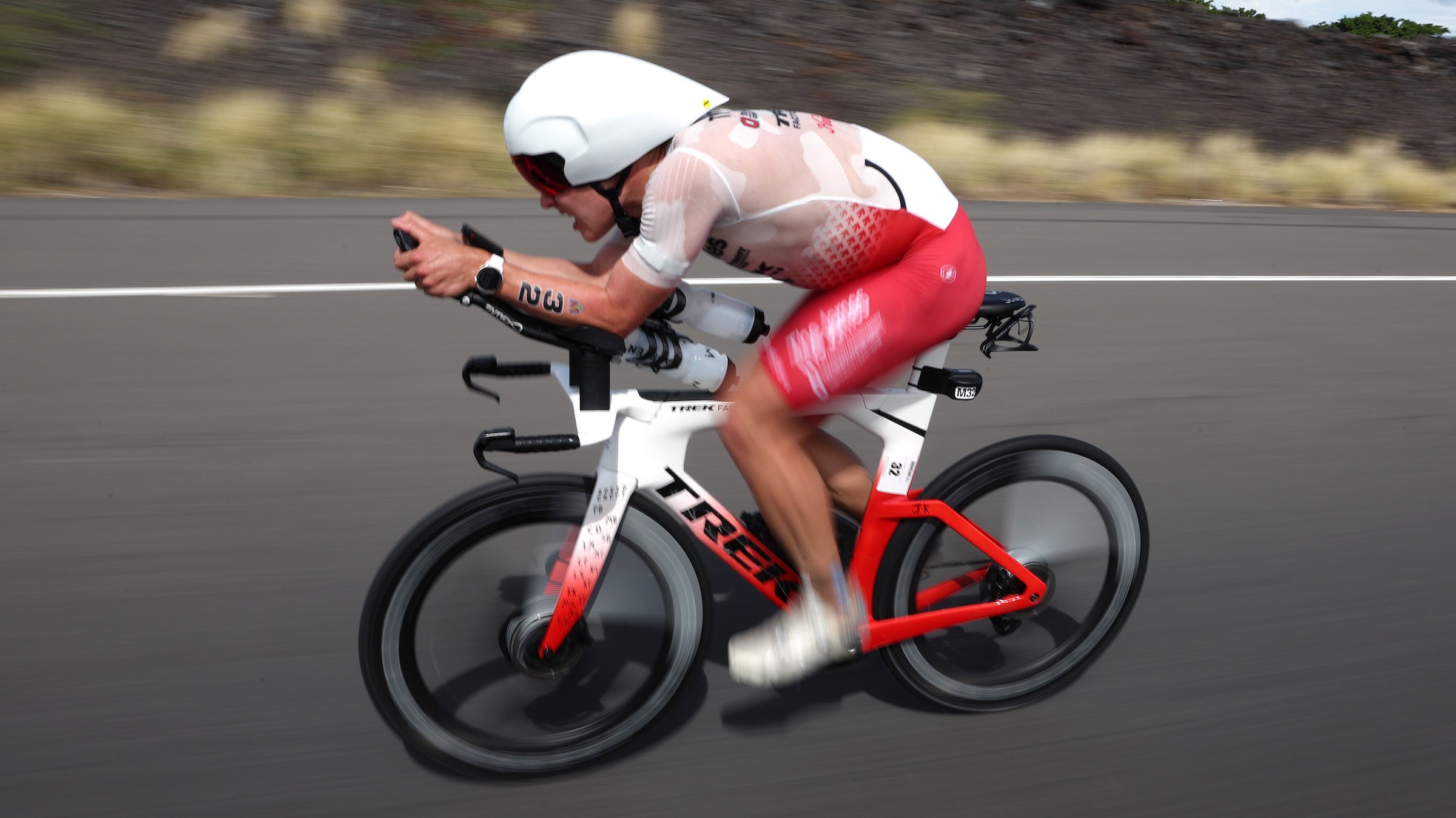
Matthew Marquardt competes in the Ironman World Championship in 2024 with two between-the-arms hydration bottles. (Photo: Ironman)
Coming into the 2024 season, Matthew Marquardt was determined to find more bike speed. “There were races where I was seeing people ride away from me,” he recalls, “even though I knew I could generate the same amount of power as them – or even more.” When he compared styles and setups to understand why, he concluded that the gaps were likely coming from their gear tweaks. “There’s an aerodynamics arms race at the pro level,” he says, “and it’s fueling technology improvements that are helping people set new records.”
To compete, Marquardt decided that he needed more than the powerful engine he displayed in notching three Ironman podiums in his 2023 rookie campaign. So he invested in wind-tunnel testing, an increasingly common practice for pros. The data from his aero trials led to a number of position and equipment changes: Marquardt lowered his head, raised his hands, changed helmets, rotated his watch face to the inside of his wrist, and switched to a tighter skinsuit.
He also adopted the hottest trend on the circuit: Stacking multiple water bottles on his cockpit. Between-the-arms (or BTA) hydration is nothing new, of course. Triathletes have been riding for years with a reservoir or bottle between their aero bars, a tactic known to reduce drag and make drinking more convenient. But standard practice was generally just a single bottle.
That all changed in the wake of Gustav Iden’s 2022 victory at the Ironman World Championship in Kona, where the Norwegian stuffed a water bottle down the front of his race kit and set an overall course record. Overnight, copycats proliferated, and studies cropped up with eye-opening claims about the potential benefits. The most frequently cited (and rigorous) report came from a Belgium research team at the Eindhoven University of Technology whose wind-tunnel simulations found hypothetical drag reductions as high as 9% – an improvement that could cut 3 or 5 or even 10 minutes over 112 miles, depending on the cyclist. (The slower you ride, the more you’d gain.)
This down-the-jersey fad didn’t last long. Ironman banned the practice going into 2024, citing a long-existing rule forbidding fairings – aka any device that is attached to a bike or rider and exists solely to reduce wind resistance.
But the seed was planted: Placing water bottles in the empty space between the chest and top tube might save as many watts – and perhaps even more – than racers had picked up from aero helmets, calf sleeves, skinsuits, and disc wheels. The scientific rationale here is quite sound – and it’s immediately obvious if you look at the Eindhoven illustrations, which the team generated using computational fluid dynamics (CFD) software. Like Iden’s bottle, an aerodynamic object placed in the cavity between your chest and top tube will divert air around your torso that would otherwise pool behind your elbows – like eddies in a river – and push against your hips, slowing your speed and costing you precious watts.
ADVERTISEMENT
Stacked between-the-arms hydration takes root
Intrigued by the CFD simulations, everyone from athletes to coaches to gear designers searched for legal alternatives to Iden’s now-banned tactic. The obvious solution was to bolt more bottle cages to existing BTA platforms. Before long, race officials were seeing cockpits with two, three, and even four bottles – some stacked horizontally and some vertically. And this was not happening just on pro bikes: By the second half of 2024, our editors were spotting new BTA configurations on numerous amateur rigs.
But is this a trend that age groupers should explore? Strong opinions exist on both sides, but the consensus seems to be a qualified yes.
Marc Graveline, an aero guru to Lionel Sanders, Chelsea Sodaro, and numerous World Tour cyclists, sees the potential for gains from stacking multiple BTA bottles but believes the more extreme claims are “more bullshit than fact.”
“ There were people who said they were finding 2 watts [of savings] and others claiming 24 watts,” he says. “I never saw 24 watts. I tested it on the road and in the wind tunnel. I tested it with a bunch of athletes. And I never saw anyone get more than 4ish watts. Some gained zero, and some were slower. When you measure it, you find that it’s extremely, extremely individual.”
ADVERTISEMENT
Graveline is a firm believer in the merits of a single BTA bottle, and he acknowledges that cyclists who haven’t optimized their hydration aerodynamics may find significant gains. But he urges age groupers to pause before copycatting. There are simply too many variables affecting the average amateur’s drag characteristics, he explains, to assume that multiple bottles will make you faster.
The biggest factors, of course, are your riding position and body type. The typical amateur isn’t the svelte 5-foot-8-inch, 143-pound male avatar used in the Eindhoven study. That hypothetical rider displayed perfect form, staying in a perfect tuck on his state-of-the-art bike throughout the simulation. He didn’t experience crosswinds, climbs, bumpy roads, or technical turns, and he didn’t have to sit up to stretch his back or grab gels at aid stations – external factors that Graveline points to as additional variables.
Sound like any triathlete or course you know?
ADVERTISEMENT
Of course not, and that’s why Graveline encourages athletes to work through adjustments and add-ons systematically, testing each one to determine what works best for them. Since your body accounts for around 80% of your drag, the most important upgrade is dialing in your position with a professional bike fitter. From there, he recommends methodical experimentation with helmets, wheels, skinsuits, and bottles.
Like Graveline, former pro and longtime coach Jimmy Riccitello thinks age groupers should look at aerodynamics holistically, taking into account variables such as weather, course design, and body type before stacking more bottles under their chests. As Ironman’s head referee, he also cautions athletes to consider safety. He’s seen numerous accidents caused by poor bike handling and fumbled water bottles, and he worries what will happen if athletes start loading several pounds of water on their cockpits: “Bikes just won’t steer the way the manufacturer intended when you put heavy fluids [high up] on the front.”
Before adding more BTA bottles, says Riccitello, ask yourself, “Can I easily access my hydration without dropping a bottle or moving off my line? Will I have to sit up and expose myself to the wind every time I drink?”
ADVERTISEMENT
Graveline and Riccitello offer the same advice: Take your BTA program one step at a time. Add a bottle to your current setup, test it, adjust it, and repeat the test/adjust process until you’re confident with the results and your steering. Then, if inclined, add another bottle and test again. But whatever you do, don’t load up the front end two weeks before your next race.

Nick Salazar, founder of TriRig.com, agrees with the cautious approach but is far more bullish on the results that average triathletes might see. “Almost all of the top-10 finishers in Kona last year were using double bottles up front,” he notes. “In one configuration or another, this [technique] is making people faster.”
Like Graveline, though, he warns against thinking that there’s one ideal location and setup that will work for everyone. Finding the most speed, he says, will require adjustments to determine where your bottles produce the greatest improvements – while remaining accessible and safe. Far forward or further back? At a 2-degree tilt or 15 degrees? Stacked end-to-end or vertically? These variables are why TriRig has focused on highly adjustable BTA components that enable cyclists to modify the placement, angle, and configuration of their bottles.
ADVERTISEMENT
Case in point is the company’s newest release, the Elevator, a riser on which you can mount an extender rail and multiple cages – then modify the tilt and stack height to suit your measurements. (We got a sneak peek at the Elevator, which hits the market on February 21 for around $200. It attaches anywhere you can bolt a bottle cage and took less than 10 minutes to mount and adjust on the top tube of my TT bike.)
Salazar doesn’t stop there, though. His bullishness about multi-bottle setups potentially upends a decades-old race strategy followed by many athletes. He argues that you should use an expanded BTA rig (and behind-the-saddle cages) to carry 100% of your hydration from mile zero of a race – rather than resupplying at aid stations, in the belief that carrying less water weight will make you faster. “ Coming out of aero [to grab a bottle] is a huge catastrophe from a drag perspective,” he says. “Avoiding a single aid station by having the additional bottle on your bike is worth 10 times whatever the weight penalty is. It’s not even remotely close. I can say categorically that if you can carry all of your fluids and it helps you stay in aero, you will go faster.”
It’s a compelling argument, and avoiding aid-station scrums almost certainly makes you safer. So while questions exist about bigger BTA rigs, the emerging gear options seem like a fruitful – and comparatively cost-effective – enhancement to explore in your ongoing search for speed.
Did more bottles make me faster?
A DIY, N=1 aero test yields intriguing results
While researching this story, I kept hearing one thing over and over: Aerodynamics are extremely individual. Every expert I spoke with recommended conducting your own testing to determine the ideal number and position of bottles on your front end.
ADVERTISEMENT
Got it. But how?
Wind-tunnel testing is the ideal option – if you can find it and afford it. Fortunately, there’s a free and fairly simple DIY alternative for the rest of us. It’s called the “Chung Method,” and this Triathlete article details the steps.
Using components from TriRig and Profile Designs, I compared two bottle configurations on my Trek Speed Concept (which is equipped with a Stages power meter and Garmin computer). The tests took place on a smooth, quiet road near my home in Boulder, Colorado, with multiple repetitions to (hopefully) reduce the margin of error.
ADVERTISEMENT
While I made every effort to control variables – like waiting for windless conditions, holding a steady position, and not changing any other equipment – my results should not be taken as a substitute for your own testing. For one thing, I’m 6 feet, 5 inches tall and ride an XXXL frame. For another, I was a history major in college, and this was my first encounter with the Chung Method. Bottom line: I’d view these findings as tantalizing and encouraging to others, but far from definitive.
Here are the configurations and results:
Legacy position: Two 16-ounce standard bottles placed inside the triangle of my frame, one on the down tube and the other on the seat tube.
BTA position: The same bottles placed end-to-end in cages attached to TriRig’s Multi-Bottle BTA Rail, which I’d bolted on top of the TriRig’s Elevator. I raised the Elevator to almost its maximum height, which positioned the bottles even with my forearms.
Results: Keeping in mind that I’m an amateur mathematician, it appears that my CDA (coefficient of aerodynamic drag) in the BTA position was 4% lower, which would save me 4-7 watts at my average speed in similar climate and road conditions. That’s not a monumental improvement, but – theoretically – it would enable me to ride 5 or more minutes faster over 112 miles without expending more energy. Which would go a long way toward a new PR.
Update 2/25/25: Ironman has amended its competition rules to follow World Triathlon’s guidance on hydration systems, limiting the amount of water an athlete can carry between their arms and behind their saddle to 2 liters in each location. Read the full story for more.